
Last Tuesday, a homeowner in Overland Park noticed that a hairline fracture in their timber wall had suddenly widened to a two inch gap after a typical spring downpour. You likely feel that same knot in your stomach every time you pull into the driveway, wondering if today is the day your landscape finally gives way. Learning how to fix a leaning retaining wall starts with understanding that the heavy, expansive clay soil throughout Johnson County exerts thousands of pounds of pressure against your property. It’s exhausting to watch your yard’s structural integrity literally tilt toward the pavement while you’re unsure of the next step.
We believe you deserve a permanent sense of security in your outdoor living space. In this guide, you’ll discover how to diagnose specific drainage failures and implement stabilization techniques that work with our local soil chemistry rather than against it. We’ll provide a clear “go or no-go” framework to help you decide between a weekend DIY project and professional intervention. From soil reinforcement to hydrostatic pressure relief, you’re about to learn the exact steps required to ensure your wall remains a beautiful, functional anchor for your home for the next twenty years.
Key Takeaways
- Understand how Johnson County’s expansive clay soil creates intense lateral pressure that leads to structural stress and visible wall leaning.
- Learn the professional “1-inch rule” to accurately measure lean and determine if your wall is a safe DIY project or an immediate collapse hazard.
- Discover the essential steps for how to fix a leaning retaining wall, including how to relieve pressure by excavating the structure’s heel.
- Master the “Gravel Sandwich” technique to implement proper drainage and protect your landscape against the unique challenges of Kansas soil.
- Recognize when to leverage local expertise to transform a failing structure into a permanent, stable, and high-end outdoor sanctuary.
Diagnosing the Lean: Why Walls Fail in Johnson County
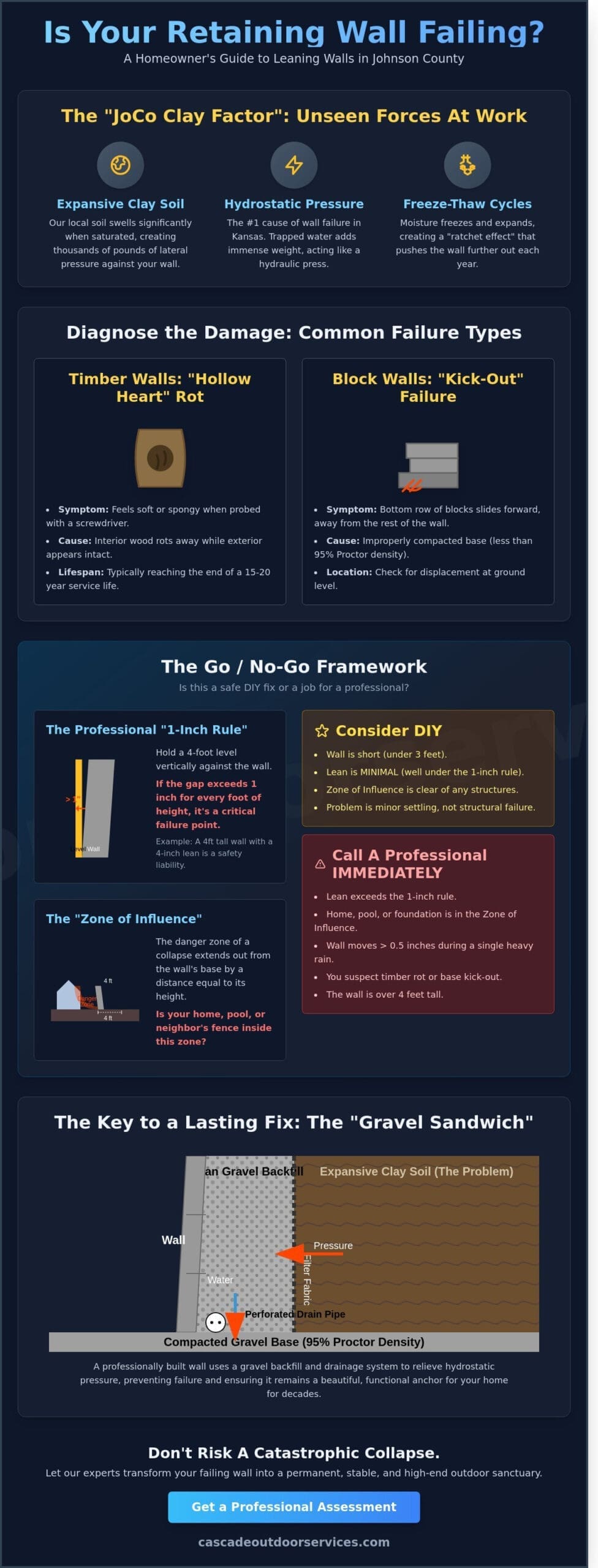
A leaning wall is rarely a standalone issue. It’s a visible symptom of structural or environmental stress that has reached a breaking point. When you see a tilt in your landscape, your retaining wall is telling you that the forces behind it have finally overcome the engineering meant to hold them back. In Johnson County, this often stems from the “JoCo Clay Factor.” Our local soil is rich in expansive clay that swells significantly when saturated. This creates thousands of pounds of lateral pressure. Understanding these forces is the first step in learning how to fix a leaning retaining wall before it becomes a total loss.
Distinguishing between minor settling and true structural failure is vital for your home’s value. Most walls experience a small degree of settling within the first 24 months of installation. However, when a wall moves more than 1 inch off its original vertical plane, it has reached a tipping point. Kansas weather cycles accelerate this movement. Our region experiences intense freeze-thaw cycles where moisture in the clay freezes and expands, pushing the wall outward. By the time summer heat arrives, the soil shrinks, leaving gaps that allow more water to infiltrate during the next storm. This cycle creates a “ratchet effect” that moves the wall further each year.
The Role of Hydrostatic Pressure
Water is the most common enemy of any hardscape project. When drainage systems fail, water collects behind the wall, adding immense weight to the soil. You’ll notice signs like “weeping” joints where water seeps through the face or surface erosion at the wall’s base. Hydrostatic pressure is the #1 cause of wall failure in Kansas. Without a clear path for runoff, the saturated earth acts like a hydraulic press against your masonry. This pressure can easily exceed the weight of the wall itself, leading to a catastrophic collapse if left unaddressed.
Timber Rot vs. Block Shifting
In older neighborhoods across Olathe and Shawnee, timber walls are reaching the end of their 15 to 20 year lifespan. Many of these structures suffer from “hollow heart,” where the interior of the wood rots away while the exterior looks intact. This makes the wall feel soft or spongy when probed with a screwdriver. Conversely, modern segmental block walls typically fail due to base issues. If the foundation wasn’t compacted to a specific 95% Proctor density, you’ll see “kick-out,” where the bottom row of blocks slides forward. Checking for this displacement at the ground level helps determine if the issue is a drainage problem or a fundamental base failure. Identifying these signs early is the key to knowing how to fix a leaning retaining wall with the right long-term solution.
Assessment: Is Your Leaning Wall a DIY Fix or a Pro Job?
Determining how to fix a leaning retaining wall begins with a simple 1-inch rule. To measure the severity of the tilt, hold a 4-foot level vertically against the wall face. If the gap between the level and the wall exceeds 1 inch for every foot of height, the structure has reached a critical failure point. A wall that is 4 feet tall with a 4-inch lean is no longer just an aesthetic eyesore; it’s a safety liability that requires immediate intervention. Beyond the measurement, you must evaluate the “Zone of Influence.” This engineering term describes the area behind and in front of the wall that will be impacted by a collapse. As a general safety standard, if a wall is 4 feet high, the danger zone extends at least 4 feet out from the base. If your home’s foundation, a neighbor’s fence, or a swimming pool sits within this radius, the risk of property damage during a DIY attempt is too high.
Professional standards, such as those detailed in the ODOT Geotechnical Design Manual, emphasize that lateral earth pressure increases exponentially when drainage fails. While a homeowner might see a slight tilt, a professional sees the thousands of pounds of hydrostatic pressure building behind the stone. If you notice your wall is moving more than 0.5 inches during a single heavy rain cycle, the internal stability is compromised. For those unsure about the structural integrity of their landscape, consulting with your local experts can provide the clarity needed to prevent a total collapse.
The Lean-to-Height Safety Ratio
Context matters when measuring a lean. A 2-inch lean on a 2-foot garden border is a structural crisis, representing a massive 8% tilt that suggests the base has shifted. You can calculate your risk by dividing the total lean by the wall height. Anything over a 1:12 ratio is a red flag. Watch for secondary signs of failure like “stair-step” cracks in mortar, separated corners where two walls meet, or a visible bulge in the mid-section. These symptoms indicate that the soil is pushing through the wall rather than the entire unit tilting together.
When DIY is (and isn’t) Possible
DIY repairs are generally reserved for decorative garden walls under 24 inches in height. Once a wall exceeds 3 feet, the physical toll of the repair becomes immense. Johnson County is famous for its heavy clay soil, which has a high plastic index. This clay holds water like a sponge; a single cubic yard of wet JoCo clay can weigh over 3,000 pounds. Digging this out by hand to replace a drainage pipe is backbreaking labor that often requires heavy machinery. Additionally, homeowners in cities like Overland Park or Leawood must consider legalities. Many local HOAs and municipal building codes require engineered drawings and permits for any wall repair exceeding 30 inches in height to ensure the new structure meets modern safety codes.
The Repair Process: How to Fix a Leaning Retaining Wall
Fixing a structural failure requires a methodical approach that prioritizes long-term stability over a quick visual fix. When our team determines how to fix a leaning retaining wall, we follow a rigorous four-step protocol designed to restore integrity and protect your property. The process begins with relieving the immense physical stress on the structure before any realignment occurs.
- Step 1: Excavate the “heel” – We remove the saturated soil behind the wall to eliminate the hydrostatic pressure that caused the initial movement.
- Step 2: Realignment – Depending on the material, we use hydraulic jacks or manual winches to pull or push the wall back to its original vertical position.
- Step 3: Lateral Support – We install anchors or deadmen that reach into the stable soil behind the wall to prevent future tipping.
- Step 4: Controlled Backfilling – We replace the old, heavy soil with clean aggregates and professional-grade drainage systems to ensure the wall stays upright.
This systematic approach ensures that the “heavy lifting” is done correctly the first time. By addressing the root cause of the lean, we transform a failing hazard into a dependable feature of your landscape. Our goal is to provide peace of mind through craftsmanship that stands up to the specific soil conditions found in Johnson County.
Realigning Timber Retaining Walls
Timber structures often fail when the original anchors rot or the spikes pull loose. To fix this, we install new 6×6 pressure-treated deadmen. These anchors extend 6 to 8 feet into the hillside, acting as a counterweight to the soil’s lateral force. If we find individual rotted beams, we replace them carefully to avoid a total collapse. We then secure the entire face with 12-inch galvanized spikes that resist corrosion and provide a seamless, tight bond between the timbers. This restoration keeps your yard looking pristine while extending the life of the wood for another 10 to 15 years.
Stabilizing Block Walls with Helical Anchors
Block walls require a more technical solution because of their weight and lack of internal fasteners. We use helical earth anchors to reach stable soil beyond the failure plane, which usually sits at a 45-degree angle from the wall’s base. During a partial rebuild, your local experts will integrate biaxial geogrid between the block layers. This mesh creates a reinforced soil mass that moves as a single unit. We finish by backfilling with 3/4-inch clean stone, compacting the material in 6-inch lifts to reach 95% Proctor density. This level of precision prevents the settling and shifting that often plagues DIY repairs.
Prevention: Ensuring Your Wall Never Leans Again
Learning how to fix a leaning retaining wall is only the first step in a long-term solution. If you reset the blocks without addressing the water trapped behind them, you’re merely delaying the inevitable. In Johnson County, our heavy clay soils expand with incredible force when saturated. This hydrostatic pressure is the primary reason walls fail. To prevent a recurrence, you must prioritize drainage over aesthetics. We utilize a “gravel sandwich” technique, which involves placing 12 to 18 inches of clean, angular gravel directly behind the wall. This layer acts as a relief valve, allowing water to drop straight down to the drain pipe rather than pushing against the structure.
Surface water management is equally vital. A single 2-inch Kansas rainstorm can dump thousands of gallons of water onto your lawn. If your downspouts discharge within 5 feet of the wall, you’re inviting disaster. We recommend extending downspouts at least 10 feet away or integrating them into a dedicated underground system. Diverting this water prevents the soil from becoming a heavy, liquid mass that even the strongest wall can’t hold back.
Mastering Yard Drainage in JoCo
Effective drainage starts with high-quality components. We use perforated 4-inch PVC pipe wrapped in a non-woven filter fabric. This fabric is essential in Johnson County because it prevents fine clay particles from clogging the system. The most critical step is “daylighting” the pipe. This means the drain must have a clear exit point at a lower elevation where water can flow away freely. Without a proper exit, the pipe just becomes a buried reservoir. For more complex properties, exploring professional yard drainage solutions is the best way to protect your investment for the next 20 years.
Choosing Better Materials for Longevity
The materials you choose dictate the wall’s lifespan. Timber walls are popular for their low initial cost, but they often rot or lean within 10 to 12 years in our humid climate. Segmental concrete blocks or natural stone offer far better performance. Natural stone is particularly effective because the small gaps between stones provide built-in “weep holes” for natural drainage. While a DIY approach might seem cheaper today, a professional retaining wall installation typically saves homeowners 30% to 50% in repair costs over a 10-year period. Our team ensures the base is compacted to 95% Proctor density, creating a foundation that stays level regardless of the season.
Don’t let a leaning wall ruin your home’s curb appeal or safety. Reach out to our team to schedule a structural assessment of your retaining wall today.
Expert Structural Solutions in Johnson County, KS
At Cascade Outdoor Services, we treat every failing wall as a structural puzzle that requires a permanent solution. When you are determining how to fix a leaning retaining wall, the first step isn’t moving dirt; it’s a forensic diagnosis. We examine the specific failure points, whether it’s a lack of proper drainage or a footing that wasn’t deep enough to withstand the freeze-thaw cycles common in Kansas. Our team prioritizes the integrity of your land, ensuring that our timber and block repairs aren’t just aesthetic upgrades but engineered reinforcements designed to last for decades.
Our “Built-to-Last” guarantee covers both structural block and timber tie systems. We utilize high-performance geo-grid reinforcements and specialized backfill techniques that exceed standard residential requirements. For homeowners in Johnson County, this means peace of mind during the heavy spring rains that often trigger wall shifts. We take pride in the heavy lifting, managing the excavation and soil stabilization so you can enjoy a safe, level yard without the stress of future collapses.
Why Local Knowledge Matters
Johnson County presents unique challenges, from the expansive clay soils to the strict municipal codes in cities like Overland Park and Shawnee. Our crews have spent years correcting failed “DIY” projects where walls were built without considering the lateral pressure of our local topography. We stay current on 2024 local building regulations, ensuring that every project meets or exceeds city safety standards. Since 2015, we’ve repaired over 200 residential walls in the area, merging precision engineering with local craftsmanship to ensure your property remains secure.
Start Your Transformation Today
Fixing a leaning wall is the first step toward a total yard refresh. While our team evaluates your structural needs, we can also discuss how our deck restoration and hardscape services can integrate into a cohesive outdoor living space. We recommend that you take four or five photos of the lean from different angles before your consultation. This helps our experts prepare a more accurate initial assessment of the soil movement and structural distress during our visit.
Don’t wait for a total collapse to address the safety of your property. Reach out to our team to secure your home’s foundation and beauty. Contact Cascade for a Retaining Wall Evaluation and let us handle the heavy lifting for you.
Secure Your Landscape with Professional Structural Repairs
A leaning wall is more than a cosmetic flaw; it’s a signal that the heavy pressure of Johnson County clay is winning. To protect your property’s value, you must address the underlying drainage issues and soil saturation that lead to structural failure. Knowing how to fix a leaning retaining wall starts with a professional assessment to determine if your timber or segmental block structure can be reinforced or if a full reconstruction is required to ensure long term stability. Since 2016, Cascade Outdoor Services has provided homeowners with dependable solutions built to withstand the specific challenges of Kansas soil. Our team brings specialized expertise to every project, ensuring your outdoor living space remains a safe and beautiful extension of your home. It’s important to act before a minor tilt turns into a total collapse. Request a Structural Wall Evaluation from Cascade Outdoor Services and let our local experts handle the heavy lifting for you. Your yard deserves the peace of mind that comes with quality craftsmanship and a foundation that stands strong for years to come.
Frequently Asked Questions
How much does it cost to fix a leaning retaining wall in Johnson County?
Repairing a leaning wall in Johnson County typically costs between $2,000 and $15,000 depending on the wall’s height and the extent of the structural damage. According to 2023 industry data from Angi, the national average for professional masonry and retaining wall repair sits at $5,322. Local costs often fluctuate based on the 12-inch gravel backfill requirements and the specific equipment needed to navigate residential lot lines in suburban neighborhoods.
Can I just push my leaning wall back and brace it with more dirt?
You shouldn’t attempt to push a wall back and brace it with soil because this fails to address the underlying hydrostatic pressure. Wet soil can exert over 100 pounds of pressure per cubic foot against your wall, and adding more dirt only increases that weight. A permanent solution requires excavating the area and installing a perforated 4-inch drain pipe to ensure water moves away from the structure rather than pushing against it.
Is a leaning retaining wall covered by homeowners insurance?
Standard homeowners insurance policies rarely cover the repair of a leaning retaining wall because they categorize earth movement and gradual wear as maintenance issues. The Insurance Information Institute states that coverage is typically limited to “sudden and accidental” perils like a fire or a vehicle collision. It’s best to check your specific policy’s “Other Structures” clause, which usually limits coverage to 10% of your primary dwelling’s value for qualifying incidents.
How long will a leaning retaining wall last before it collapses?
A leaning wall can remain upright for several seasons or collapse during a single 2-inch rainfall event. Structural engineers often identify a 15-degree tilt as the critical point where the center of gravity shifts beyond the wall’s base. Once you notice 3 inches of separation between the wall and the soil, the structural integrity is compromised, and a total failure becomes a matter of when, not if.
What is the best material for a replacement retaining wall in Kansas?
Segmental concrete blocks are the most reliable material for the Kansas climate because they withstand the 40-degree temperature swings that cause solid concrete to crack. These interlocking units provide a 50-year design life and allow for the natural expansion and contraction of the heavy clay found in Olathe and Overland Park. Since 2015, these engineered systems have become the standard for homeowners seeking a balance of rugged durability and high-end curb appeal.
Do I need a permit to repair a retaining wall in Overland Park or Olathe?
You need a permit in both Overland Park and Olathe if the retaining wall exceeds 4 feet in height measured from the bottom of the footing. Overland Park Municipal Code Section 18.390 requires a structural engineer’s seal for walls over this height to ensure the design can handle the local soil loads. For smaller walls under 3 feet, a permit is usually not required, but you must still follow local setbacks and utility easement rules.
Can a leaning wall be fixed without tearing it all down?
Some walls can be stabilized using helical anchors or soil nails if the original blocks are still in good condition. This method involves driving steel shafts 10 feet into the stable ground behind the wall to pull the structure back into alignment. However, learning how to fix a leaning retaining wall often reveals that if the original contractor skipped the drainage layer, a partial teardown is the only way to guarantee a 20-year lifespan for the repair.
Planning a retaining wall in Johnson County?
Cascade Outdoor Services builds and rebuilds retaining walls across Johnson County, Kansas — Overland Park, Olathe, Shawnee, Lenexa, Leawood and Prairie Village. We engineer for JoCo clay, drain the wall properly from the start, and put the scope in writing before work begins.
Takes about two minutes. Prefer to talk it through? Call (913) 299-5613 — we answer the phone.