
Picture a crisp Tuesday morning in Leawood. The sun is shining, but a shaded corner of your parking lot has turned into a sheet of black ice after a midnight melt. When a tenant slips, the difference between a minor incident and a devastating lawsuit often comes down to the fine print in your contractor’s policy. Understanding commercial snow removal insurance requirements isn’t just about checking a box. It’s about protecting the long term health of your Johnson County property and your bottom line.
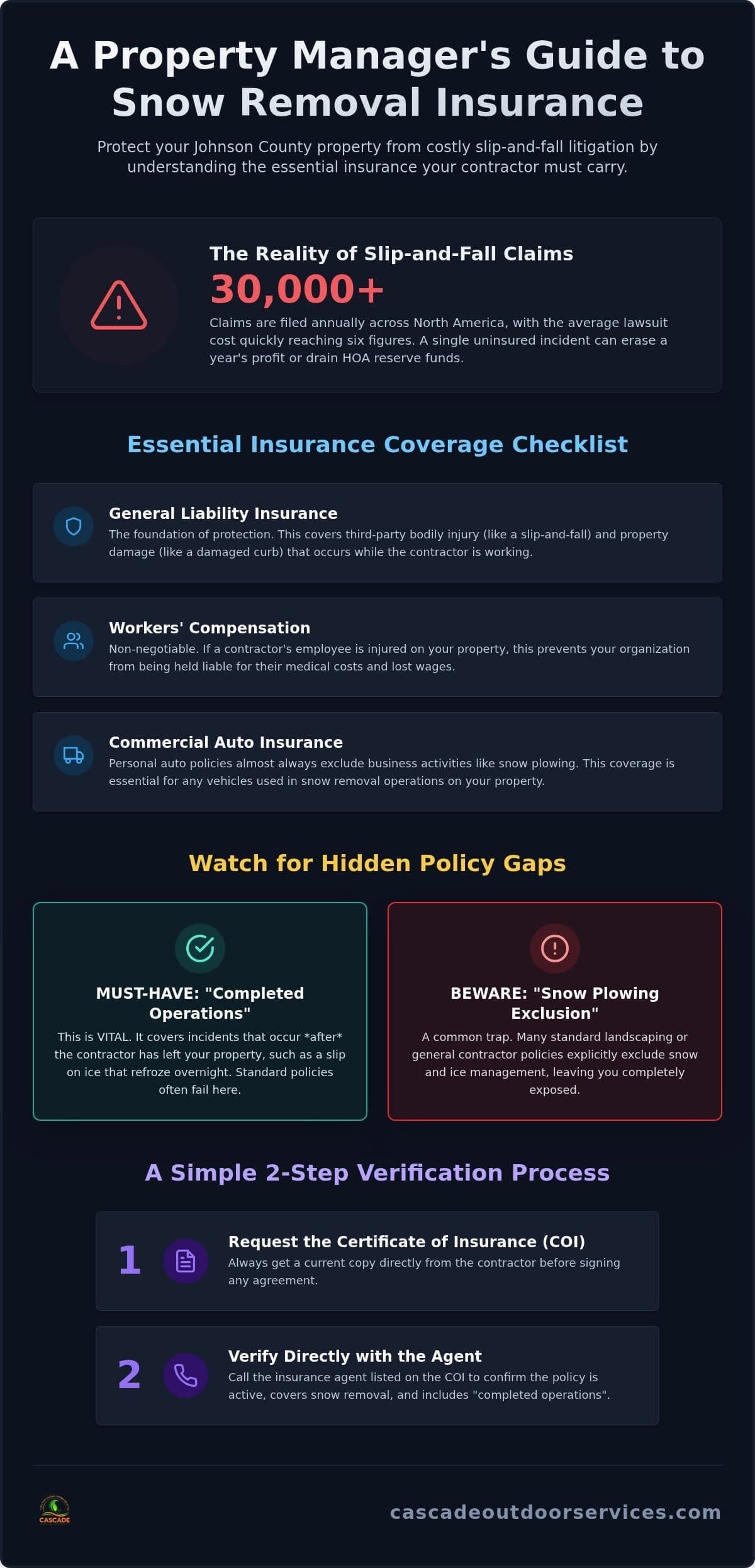
With over 30,000 slip and fall claims filed annually, the stakes for property managers are incredibly high. You likely already know that a handshake deal with an under-insured operator is a liability trap, yet the jargon can be exhausting to sort through. This guide provides the peace of mind you need by outlining the essential insurance standards and liability protections required for professional snow management. We’ll explore the critical “Completed Operations” endorsement, explain why standard policies often fail, and provide a clear checklist to ensure your organization is never left out in the cold.
Key Takeaways
- Understand why specialized coverage is non-negotiable for Kansas City winters and how it shields your organization from costly slip-and-fall litigation.
- Identify the essential commercial snow removal insurance requirements you should mandate, including General Liability and Workers’ Compensation, to ensure total property protection.
- Learn how to spot the “Snow Plowing Exclusion” hidden in standard landscaping policies and why “Completed Operations” coverage is vital after the plow leaves your lot.
- Master a simple two-step process for verifying a contractor’s Certificate of Insurance (COI) directly with their agent to confirm authentic, active coverage.
- Discover how prioritizing professional drainage and local expertise can proactively reduce ice buildup and lower your liability risks throughout the season.
Why Commercial Snow Removal Insurance Requirements Matter in Johnson County
Commercial snow insurance is a specialized suite of coverages designed to protect both the contractor and the property owner from winter-related accidents. It goes far beyond a standard landscaping policy. In our region, meeting strict commercial snow removal insurance requirements is the only way to ensure that a single patch of ice doesn’t become a financial catastrophe for your organization. While snow removal is performed by individual households and by governments institutions, commercial properties carry a unique burden of care that requires professional-grade protection.
Kansas City winters are notoriously unpredictable. We often deal with “ice events” where rain turns to sleet and then freezes solid as temperatures drop. These events create significantly more liability than heavy snow accumulation because ice is often deceptive and harder to manage. If a contractor lacks the proper coverage, the property owner may face vicarious liability. This legal concept means you can be held responsible for the contractor’s negligence. There’s a vast difference between a residential “plow guy” with a truck and a professional management team that treats your lot with precision and carries the weight of full legal protection.
The Reality of Slip-and-Fall Claims in Kansas
Slip-and-fall claims are a major industry risk that property managers can’t afford to ignore. With over 30,000 claims filed annually across North America, the average cost of a lawsuit can quickly reach six figures when medical bills and legal fees are tallied. Kansas law generally holds property owners responsible for clearing snow and ice from their sidewalks and driveways. Local courts look for “reasonable care” when evaluating these cases. They want to see that you took proactive steps to mitigate hazards. Documentation is just as critical as the commercial snow removal insurance requirements themselves. If you can’t prove when the salt was spread or the lot was cleared, your defense becomes much harder to maintain during a dispute.
Protecting Your HOA or Commercial Asset
For HOAs and business owners, insurance is about asset preservation and long-term stability. A single un-insured claim can drain HOA reserve funds or erase a year’s worth of commercial profit. Beyond the legal risks, professional snow removal protects your physical investment from unnecessary wear. Amateur operators who lack specialized training often damage curbs, natural stone retaining walls, or expensive pavers. By choosing Cascade’s commercial snow services, you’re partnering with a team that understands local weather patterns and maintains the high professional standards required to keep your property safe, functional, and beautiful through the toughest months of the year.
Essential Insurance Coverages for Professional Snow Contractors
Professional snow management involves more than just a truck and a shovel. It requires a robust safety net that protects your assets from the inherent risks of winter operations. When evaluating commercial snow removal insurance requirements, you should look for a comprehensive package that includes General Liability, Workers’ Compensation, and Commercial Auto insurance. General Liability serves as the foundation, covering third party bodily injury and property damage. However, Understanding the ‘Completed Operations’ and ‘Slip and Fall’ Liability Gap is crucial, as standard policies might exclude incidents that occur after the contractor has left the site. Workers’ Compensation is equally vital; without it, your organization could be held liable for injuries sustained by a contractor’s employee while working on your lot.
Commercial Auto insurance is necessary because standard personal or general business auto policies often exclude snow plowing activities. For high traffic commercial sites or large HOAs, an Umbrella or Excess Liability policy provides additional layers of protection that go beyond the basic limits. This ensures that even in the event of a catastrophic accident, your financial exposure remains limited. These layers of defense represent the quiet satisfaction of quality craftsmanship, knowing that every detail, from the blade to the policy, is handled correctly.
Recommended Coverage Limits for 2026
In 2026, the industry standard for General Liability is typically a minimum of $1,000,000 per occurrence and $2,000,000 aggregate. The aggregate limit is the maximum amount the insurer will pay during the policy period. If a contractor manages multiple large accounts, a single major claim elsewhere could exhaust their coverage before they even reach your property. A ‘Per Project Aggregate’ endorsement ensures that the insurance limits remain dedicated to your specific property rather than being depleted by claims at other locations. Verifying these limits is a proactive step in maintaining the professional property maintenance standards your tenants expect.
Inland Marine: Protecting the Equipment on Your Site
While General Liability covers the damage equipment might cause, Inland Marine insurance covers the equipment itself, such as salt spreaders, skid steers, and specialized snow blowers. This matters to property managers because a contractor with un-insured equipment is more likely to experience prolonged downtime following a breakdown or theft. Reliable, well maintained equipment is a hallmark of a disciplined team. When a contractor invests in protecting their tools, they are also investing in the perennial reliability of your site’s winter safety plan. This focus on longevity ensures that your grading and drainage systems aren’t compromised by faulty machinery during a storm.
Understanding the ‘Completed Operations’ and ‘Slip and Fall’ Liability Gap
Many property managers assume that if a contractor has General Liability (GL) insurance, they’re covered. This is a dangerous misconception. Standard landscaping policies often contain a “Snow Plowing Exclusion.” Without a specific endorsement, the policy is essentially void the moment the plow hits the pavement. Meeting commercial snow removal insurance requirements means verifying that this exclusion has been removed by the insurer. Understanding these commercial snow removal insurance requirements is the only way to bridge the gap between a cleared lot and a protected organization.
The most significant liability gap is “Completed Operations.” Most slip and fall incidents don’t happen while the truck is moving. They happen hours or days later when meltwater refreezes into black ice as the sun goes down. If a contractor doesn’t have Completed Operations coverage, their insurance won’t pay for a claim filed after they leave the lot. Professional salting strategies are your first line of defense. By using the right products at the right time, we prevent the bond between ice and pavement. This proactive approach drastically reduces the likelihood of a claim ever being filed, ensuring your walkways remain safe long after the storm has passed.
The ‘Care, Custody, and Control’ Exclusion
Damage to your property is another common issue that requires specific attention. A plow might hit a timber retaining wall or a commercial bollard during a heavy storm when visibility is low. The “Care, Custody, and Control” exclusion in some policies can prevent you from recovering costs for damage to the property the contractor was hired to service. It’s vital to ensure their policy covers the physical assets on your site. At Cascade, we focus on the long term health of your property. We often integrate professional drainage solutions to prevent ice at the source. By managing water runoff effectively, we reduce the need for heavy machinery near sensitive hardscaping and minimize the risk of structural damage that can occur during aggressive plowing.
Contractual Indemnification and ‘Hold Harmless’ Agreements
Indemnification and “Hold Harmless” clauses define the legal relationship between the property manager and the snow contractor. These clauses require the contractor to defend the property manager in court if a lawsuit arises from the contractor’s work. To make this “shield” effective, an “Additional Insured” endorsement is non-negotiable for commercial contracts. This gives you direct access to their insurance limits and ensures your own organization’s policy isn’t the first one on the hook. These legal layers provide the peace of mind that comes from a well executed, professional partnership where the risk is managed as carefully as the snow itself. It creates a clear boundary that protects your HOA’s reserve funds or your business’s bottom line from third party negligence.
How to Verify a Snow Removal Contractor’s Certificate of Insurance (COI)
Property managers often receive a stack of paperwork during the bidding season. It’s tempting to glance at a Certificate of Insurance (COI) and assume everything is in order. However, true verification requires a more disciplined approach to ensure your property meets all commercial snow removal insurance requirements. You don’t want to discover a policy is invalid only after an accident occurs. Follow these four steps to confirm your contractor is as protected as they claim to be.
- Request the COI directly from the insurance agent. Don’t just accept a PDF from the contractor. Getting the document straight from the agent ensures the policy hasn’t been canceled for non-payment or altered.
- Check the ‘Description of Operations’ carefully. This section must explicitly mention snow plowing or ice management. If it only lists general landscaping, the insurer may deny any winter-related claims.
- Verify the expiration dates. Ensure the coverage remains active through the entire winter season, typically from November through April. Many policies renew in the middle of winter, so mark your calendar to request an updated COI in January.
- Confirm ‘Additional Insured’ status. Your business or HOA should be listed on a primary and non-contributory basis. This ensures the contractor’s insurance pays first in the event of a claim, protecting your own policy limits.
Spotting Red Flags on a COI
Watch for warning signs that suggest a contractor is cutting corners. Generic landscaping codes without specific snow endorsements are a major red flag. If the limits are lower than your contract requires, or if the policy has recently lapsed, the contractor isn’t ready for professional commercial work. A handwritten Certificate of Insurance is an immediate sign of potential fraud and should be grounds for the instant rejection of any bid. These inconsistencies suggest a lack of the moral consistency and professional eye required to manage a high-value property. You need a partner who values the physical labor and the paperwork with equal discipline; looking at the rigorous operational standards of companies like Maintenance Time Inc provides an excellent benchmark for what professional exterior maintenance should look like.
Insurance is your financial safety net, but documentation is the evidence that keeps that net from breaking. In a slip-and-fall dispute, your best defense is a clear record of every action taken on your site. GPS tracking and digital logs prove exactly when a plow entered your lot and when the salt was spread. Time-stamped photos of cleared walkways provide undeniable proof of “reasonable care” during a storm. This level of detail transforms a standard service into a premium property maintenance experience.
At Cascade, we prioritize this transparency through precision monitoring and detailed service reporting. We don’t just clear the snow; we provide the data you need to satisfy commercial snow removal insurance requirements and protect your organization. If you’re ready to partner with a team that values long-term property health, explore our commercial snow management services today and experience the peace of mind that comes from a well-executed winter plan.
Partnering with an Insured and Reliable Snow Management Team in JoCo
Choosing a contractor who respects commercial snow removal insurance requirements is about more than just legal compliance. It’s about finding a partner who values your property as much as you do. Cascade Outdoor Services prioritizes transparency and professional standards because we know that a well maintained environment provides peace of mind. As a locally owned business since 2016, we understand the unique weather patterns of Johnson County. We’ve seen how quickly a sunny afternoon can turn into a dangerous ice event, and we’re prepared to respond before the first flake falls. Our deep appreciation for the local environment drives us to provide a service that is both rugged and sophisticated; this same commitment to professional reliability should extend to all your vendors, including specialized services like KC Frost Wagon for commercial cooler and freezer trailer rentals.
Integrating your snow management with year-round property maintenance creates a seamless transition between seasons. When the team clearing your snow is the same one that installed your landscape, they know exactly where the delicate curbs and natural stone features are located. This familiarity reduces the chance of damage and ensures your property remains beautiful throughout the winter metamorphosis. Starting your 2026 commercial snow contract evaluation early allows you to secure a partner who is fully equipped and meets all commercial snow removal insurance requirements before the peak season rush.
Precision in snow removal starts with the right equipment. Using late-model plows and calibrated spreaders reduces the risk of property damage, which in turn keeps insurance claims low. For HOAs and retail centers in Overland Park and Olathe, our quick response and prompt replies keep you covered. We track every storm with meticulous detail so you don’t have to worry about the safety of your tenants or customers. This disciplined approach is a vital part of Cascade’s property maintenance services, ensuring every exterior space is a functional and beautiful extension of your property.
Request a Professional Snow Management Consultation
Every property has its own set of challenges, from steep inclines to complex drainage patterns. Our process begins with a comprehensive property walk-through and risk assessment to identify potential “trouble spots” where meltwater might collect and refreeze. This proactive attitude allows us to manage those areas before they become a liability. You can customize your contract based on specific triggers that meet your organization’s needs:
- 1-Inch Trigger: Ideal for high-traffic retail centers and medical offices.
- 2-Inch Trigger: Often preferred by HOAs and industrial complexes.
- Zero-Tolerance Salting: Continuous monitoring for black ice and refreezing events.
Don’t wait for the first storm to test your liability. A professional consultation ensures that your contract is tailored to the specific terrain of your site. It’s the knowledgeable neighborly approach that gets the job done correctly the first time. To protect your landscape and your bottom line, secure your commercial snow contract with Cascade Outdoor Services today and experience the quiet satisfaction of quality craftsmanship all winter long.
Protecting Your Johnson County Assets This Winter
Managing a commercial property in Johnson County requires a proactive approach to risk. By now, you understand that meeting commercial snow removal insurance requirements is about more than just holding a certificate; it’s about closing the “Completed Operations” gap and ensuring your contractor has the right endorsements for Kansas City’s unique ice events. Verifying a contractor’s coverage directly with their agent and checking for specific snow removal language provides the legal shield your organization needs to stay resilient through the coldest months.
Cascade Outdoor Services handles the heavy lifting so you don’t have to. As a fully insured and locally owned partner, we specialize in Johnson County HOA and commercial sites. Our team keeps a close eye on the forecast and manages each site with precision to keep your lot safe and your liability low. Don’t let a single storm compromise your property’s long term health or your budget’s stability.
Take the first step toward a worry-free season. Get a Quote for Commercial Snow & Ice Management and experience the peace of mind that comes from professional, local expertise. We’re ready to protect your property and your bottom line.
Frequently Asked Questions
What is the most important insurance for a snow removal company?
General Liability insurance with a specific endorsement for winter operations is the most critical coverage for any snow removal company. This policy protects against third party bodily injury and property damage claims. While other coverages like commercial auto are necessary, General Liability is the primary defense against slip and fall lawsuits. You must ensure the policy doesn’t have a snow exclusion clause, which is common in many landscaping focused insurance packages.
Does standard business insurance cover snow plowing?
Standard business insurance typically doesn’t cover snow plowing activities without a specific rider or endorsement. Many property managers are surprised to learn that a contractor’s landscaping policy often has a hidden exclusion for winter services. To meet commercial snow removal insurance requirements, you must verify that the policy explicitly includes snow and ice management. Working with a specialized provider ensures that these high risk activities are fully covered by the insurer.
What are ‘Additional Insured’ endorsements in snow removal contracts?
An ‘Additional Insured’ endorsement adds your organization to the contractor’s insurance policy for the duration of the contract. This provides you with a direct line of defense if a lawsuit is filed against your property due to the contractor’s work. It ensures that the contractor’s insurance is primary and non-contributory, meaning their policy pays out first before your own business insurance is ever triggered. This is a non-negotiable standard for commercial property contracts.
How much general liability insurance should a snow plow contractor have?
Most professional commercial contracts in Johnson County require a minimum of $1,000,000 per occurrence and $2,000,000 in the aggregate for General Liability insurance. For high traffic retail centers or large medical complexes, you should consider requiring an umbrella policy that increases coverage to $5,000,000 or more. These higher limits reflect the potential cost of medical bills and legal fees associated with serious slip and fall injuries on a busy commercial site.
What happens if my snow contractor isn’t insured and someone slips?
If an uninsured contractor is negligent and an accident occurs, the legal and financial responsibility typically falls on the property owner or management company. This is known as vicarious liability. In the absence of a contractor’s policy, the claimant will target your organization’s assets or insurance. This can lead to massive out of pocket expenses, increased premiums, and a significant drain on HOA reserve funds. Verifying commercial snow removal insurance requirements is your primary defense against this outcome.
What is ‘Completed Operations’ coverage in snow management?
Completed Operations coverage protects against claims that arise after the snow removal work is finished and the contractor has left the property. For example, if snow melts during the day and refreezes into black ice at night, a standard policy might not cover the resulting fall. Completed Operations ensures that the contractor is still insured for these delayed incidents. This is a vital component of any professional snow management contract in the Kansas City area.
Should I require Workers’ Comp if the contractor is a sole proprietor?
You should always require Workers’ Compensation insurance, even if the contractor claims to be a sole proprietor with no employees. If a sole proprietor is injured on your property or hires a helper who gets hurt, they could sue your organization for medical costs and lost wages. Verifying this coverage ensures that any job related injuries are handled through the proper insurance channels rather than becoming a costly liability for your property or business.
How often should I request an updated COI from my snow removal company?
You should request an updated Certificate of Insurance (COI) at the start of every season and whenever a policy is set to expire. Many insurance policies renew on January 1st, right in the middle of the Kansas winter. If you don’t request a new certificate, you might be relying on an expired policy during the most dangerous months. It’s a best practice to keep a digital file of these documents and verify them directly with the insurance agent.