
Imagine watching a spring storm roll across the Kansas plains, only to realize that instead of nourishing your lawn, the rainwater is pooling into a stagnant pond just feet from your foundation. For many homeowners in our area, the heavy clay soil acts like a bowl, holding moisture for days and slowly pushing it toward the basement walls. You aren’t alone if you’ve spent the morning checking the sump pump or worrying about new cracks in the crawlspace. Proper landscape grading for drainage Johnson County KS is the invisible foundation that ensures your property remains a sanctuary rather than a source of stress.
We understand the quiet pride that comes from a well-maintained home and the frustration when nature seems to work against you. This guide will show you how professional grading protects your home’s structural integrity while transforming soggy, unusable patches into a dry, functional backyard. We’ll explore the unique challenges of our local terrain, the latest regional stormwater standards, and how a natural-looking slope can provide a permanent solution to erosion and seepage. By the end, you’ll know exactly how to achieve a landscape that is as resilient as it is beautiful.
Key Takeaways
- Understand how reshaping your land prevents hydrostatic pressure from causing costly foundation cracks and structural shifts.
- Discover why Johnson County’s heavy clay soil sheds water like a roof and how to manage its unique seasonal expansion cycles.
- Learn the critical differences between surface grading and French drains to determine which method best addresses your specific water issues.
- Master the professional process of landscape grading for drainage Johnson County KS, including the importance of laser leveling and precision site transit.
- Gain peace of mind by prioritizing structural landscape improvements that safeguard your property’s long-term health and curb appeal.
What is Landscape Grading and Why is it Critical in JoCo?
Landscape grading is the deliberate process of reshaping the ground’s surface to control the flow of rainwater. While it might look like simple dirt work, it’s actually a form of Grading in civil engineering that establishes a specific slope to protect your home. In our region, professional landscape grading for drainage Johnson County KS serves as the primary shield against water intrusion. It is the first line of defense, ensuring that runoff moves away from your home naturally before you ever need to rely on mechanical systems like sump pumps or interior drains.
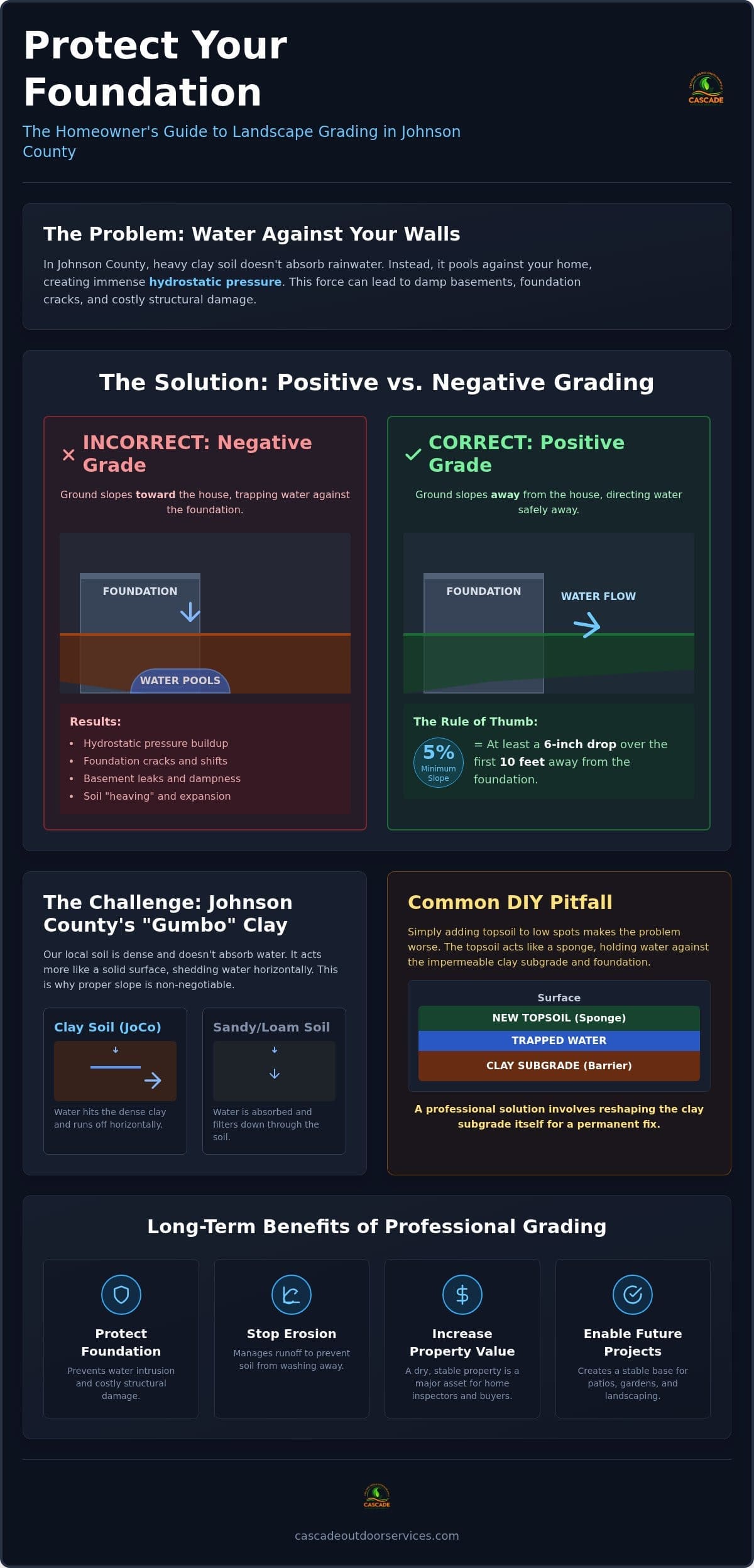
The most critical rule we follow for property protection is the “Positive Grade.” This standard requires the ground to slope away from your foundation at a minimum of 5%. To visualize this, you need at least six inches of vertical drop within the first ten feet of distance from your home’s exterior walls. This slope prevents hydrostatic pressure, which is the heavy force exerted by standing water against your foundation. If water sits against your basement walls, it eventually finds its way through microscopic pores in the concrete, leading to persistent dampness or even structural failure.
The Danger of Negative Grading
Negative grading occurs when the ground slopes toward your house rather than away from it. This often happens over time as the original backfill soil used during construction settles near the foundation. When we evaluate landscape grading for drainage Johnson County KS, we frequently find “birdbaths” or low spots that trap runoff. When water pools in these areas, it saturates the soil and causes “heaving,” where the ground expands and puts immense pressure on your basement or crawlspace walls. You can spot early failure by looking for spongy turf after rain, soil pulling away from the foundation, or white, powdery mineral deposits on interior basement walls.
Protecting Your Property Value
Maintaining a proper grade is one of the smartest investments a homeowner can make for long-term property health. During a property sale, home inspectors in Overland Park and Olathe prioritize grading because it dictates the longevity of the entire structure. Addressing a slope issue now is significantly more affordable than foundation piering, which can cost tens of thousands of dollars once the damage is done. While we focus on preventative grading in Kansas, companies like Crown Leveling Inc. specialize in the structural repairs that become necessary when water is allowed to undermine a foundation over time. Beyond structural protection, a correctly graded yard provides the stable, dry base required for high-quality landscape design or new stone patios, ensuring your outdoor investments don’t wash away during the next heavy storm.
The Challenge of Johnson County’s Heavy Clay Soil
Johnson County is known for its “gumbo” clay, a soil type that presents a unique set of challenges for any property owner. Unlike sandy or silty soils that allow water to filter through, our local clay is composed of microscopic, flat particles that pack together with incredible density. This structure means the ground doesn’t absorb water; instead, it sheds it like a shingle roof. Without precision landscape grading for drainage Johnson County KS, rainwater simply sits on the surface, creating the persistent mud and standing pools that plague many local backyards.
This soil also goes through a dramatic expansion and contraction cycle. During our hot Kansas summers, the clay dries out and develops deep cracks. When the spring rains arrive, the clay absorbs moisture, swells, and exerts massive pressure on anything buried within it. Because the earth refuses to let water percolate downward, we must design the landscape to move water horizontally. We often use swales, which are wide, shallow channels integrated into the turf, to provide a clear path for high-volume runoff to exit your property without causing erosion.
Clay vs. Silt: A Local Comparison
The “tightness” of our soil is the primary reason why simple DIY fixes often fail. Homeowners frequently try to solve a soggy yard by “just adding topsoil” to low spots. This actually makes the problem worse. The loose topsoil acts like a sponge, holding water against the foundation while the underlying clay prevents it from ever draining away. Professional grading involves stripping back these layers and compacting the clay subgrade itself at the correct pitch. By addressing the structural layer of the earth, we create a permanent solution. If you’re struggling with a yard that won’t dry out, our team can provide a professional assessment through our grading and drainage services.
Managing Runoff in Heavy Rains
A typical Johnson County thunderstorm can dump a staggering volume of water in a very short time. For a standard 2,000 square foot roof, just one inch of rain generates over 1,200 gallons of runoff. When that water hits the non-porous clay, it moves fast. Proper grading accounts for this velocity by ensuring the pitch is steep enough to keep water moving but gentle enough to prevent soil washout. Understanding these local conditions is vital for improving heavy clay soils and protecting your home. Clay creates “perched water tables” in residential yards by trapping water in upper soil layers above an impermeable clay base, preventing downward drainage.
Grading vs. French Drains vs. Catch Basins
Choosing the right water management strategy requires understanding how water moves through your specific property. While many homeowners assume a single pipe will solve their issues, the most effective solutions often involve a combination of techniques. Professional landscape grading for drainage Johnson County KS is almost always the starting point because it addresses surface water naturally. By reshaping the land, we use gravity to guide runoff toward the street or a designated swale before it can ever reach your foundation.
However, grading alone cannot always solve every problem. Here is how the three primary methods differ in a functional landscape:
- Grading: This is the most effective method for moving large volumes of surface water over long distances. It relies on the natural slope of the earth to shed water.
- French Drains: These are designed to capture subsurface groundwater. If your yard feels like a wet sponge days after a storm, a French drain uses a perforated pipe and gravel to pull water out of the saturated soil.
- Catch Basins: These are specialized grates placed in localized low spots where water tends to stand. They are ideal for areas near patios or at the base of a steep slope where water collects in a “bowl.”
Integrated systems often provide the best results. We might use landscape grading to move the majority of the water, then install a catch basin in a stubborn low spot to ensure the yard remains dry and usable.
When is Grading Enough?
In many cases, a simple re-slope is the only intervention needed. If your property has enough elevation change to allow for a 5% slope, we can usually fix drainage issues without digging deep trenches for pipes. Passive grading is the preferred choice because it requires zero maintenance and looks completely natural within your landscape design. It’s a permanent structural fix that works 24/7 without any mechanical parts to fail. You can learn more about our grading and drainage services to see if a re-slope is the right solution for your yard.
When Drains are the Better Choice
Sometimes, the geography of a lot in Overland Park or Olathe simply doesn’t allow for a natural slope. On very flat lots, we cannot achieve the necessary pitch to move water with dirt alone. In these scenarios, French drains or catch basins become essential. They are also critical for protecting the structural integrity of retaining walls by relieving the water pressure that builds up behind the stone or timber. If you are considering a pipe-based system, be sure to avoid these 5 French Drain Mistakes JoCo Homeowners Make to ensure your investment lasts for decades.
The Professional Landscape Grading Process
Professional landscape grading is a structured metamorphosis of your property. It requires more than just a skid steer; it requires a disciplined eye and specialized tools. To see examples of the specialized machinery used for precision site work, you can discover Ladbrokes Hire and their guide to compact earthmoving equipment. When executing landscape grading for drainage Johnson County KS, our team follows a methodical five-step progression to ensure water moves exactly where it belongs. This isn’t just about moving dirt; it’s about engineering a permanent solution for your home’s exterior environment.
The process starts with laser leveling and site transit. We identify precise low spots that the naked eye might miss. Next, we coordinate utility marking and clearing, ensuring all underground lines are flagged before any earth moves. The third step is rough grading, where we excavate and move soil to establish the core slope. This is followed by compaction and finish grading. Because our local clay is so prone to shifting, we use heavy equipment to pack the layers, creating a smooth surface that won’t settle into new puddles later. Finally, we provide stabilization through sod, seed, or stone to lock the new grade in place permanently.
Guessing with the naked eye is the primary cause of “puddle jumping,” where water simply moves from one low spot to another without ever leaving the yard. When we design landscape grading for drainage Johnson County KS, we use high-accuracy transits to ensure every square inch of your yard contributes to a positive flow toward the street or storm drain. This engineering phase also carefully accounts for neighbor property lines. We take pride in being a responsible partner in the community, ensuring your drainage solution doesn’t become your neighbor’s problem while staying in strict compliance with local Johnson County runoff regulations.
Soil Stabilization and Restoration
Newly graded soil is highly vulnerable to erosion during the first heavy Kansas rainstorm. We prioritize immediate restoration to protect the integrity of the new slope. Depending on the season, we help you choose between sod installation for instant protection or high-quality seeding. Beyond just a healthy lawn, proper grading serves as the essential structural foundation for future patio hardscapes. Without a stabilized, correctly pitched base, even the most expensive stone patio will eventually shift, crack, or sink.
If you’re ready to fix your yard’s slope correctly the first time, contact Cascade Outdoor Services to schedule your professional site evaluation.
Why Choose Cascade for Your Johnson County Grading Project?
Selecting a partner for your property’s structural health requires more than just finding a crew with a tractor. At Cascade Outdoor Services, we view your yard as a vital extension of your home’s interior, deserving the same level of architectural precision. Since 2016, we’ve focused exclusively on the structural elements of the landscape. While generalist companies might offer mowing or basic maintenance, we specialize in the complex physics of landscape grading for drainage Johnson County KS. Our team understands the specific terrain of Overland Park and Olathe, where the rolling hills and dense clay require a nuanced approach to water management.
Our “Correct the First Time” philosophy is built on the belief that preventative grading is the most cost-effective way to preserve your home’s value. We don’t believe in temporary patches that wash away with the next spring storm. Instead, we implement long-term solutions that prevent the need for invasive foundation piering or basement waterproofing. By addressing the root cause of water intrusion, we provide the peace of mind that comes from knowing your basement will stay dry even during a Kansas deluge. This disciplined approach to site management ensures that every project is executed with punctuality and professional cleanliness.
Our Commitment to Johnson County
As a locally owned business founded in 2016, we have a deep appreciation for the local environment. We’ve spent years studying how our regional climate patterns affect soil behavior, particularly the expansion and contraction of our native clay. Our craftsmen take immense pride in the physical labor required to transform a neglected, soggy space into a polished, functional environment. We aren’t just moving dirt; we’re building outdoor environments that last for generations. This dedication to quality craftsmanship has made us a trusted partner for property owners who value both the functionality of a dry yard and the refined aesthetics of premium property maintenance.
Getting Started with Your Estimate
Every property presents a unique set of challenges, which is why we begin every project with a professional drainage consultation. We evaluate your existing slope, identify problematic low spots, and discuss custom solutions that fit your specific goals. Whether you’re navigating strict HOA requirements in a residential neighborhood or managing a large-scale commercial site, we provide the technical expertise to keep your project in compliance with local regulations. You don’t have to live with a muddy yard or a damp crawlspace. You can schedule your professional grading estimate today to begin the transformation of your property.
Secure the Long-Term Health of Your Property
A dry, stable backyard is the result of intentional engineering and an intimate understanding of the Kansas terrain. We’ve explored how a precise 5% slope acts as your first line of defense against foundation damage, especially when dealing with the non-porous nature of our local clay. By choosing a professional approach to landscape grading for drainage Johnson County KS, you aren’t just fixing a muddy spot; you’re making a structural investment that safeguards your home’s value for decades to come.
At Cascade Outdoor Services, we’ve been locally owned and operated since 2016. As specialists in structural outdoor construction, we bring the right tools and local expertise to solve even the most complex drainage challenges. Our team takes pride in getting the job done correctly the first time, so you can enjoy your outdoor space without the stress of the next heavy rain. Don’t wait for the next storm to test your foundation’s limits. Get a Professional Grading Estimate for Your Johnson County Property today. We look forward to helping you transform your yard into a resilient, beautiful extension of your home.
Frequently Asked Questions
How much does landscape grading cost in Johnson County?
Total cost depends on the square footage of the area and the volume of soil being moved or imported. Factors like backyard accessibility and the need for specialized equipment also influence the final investment. While every property is unique, professional landscape grading for drainage Johnson County KS serves as a vital preventative measure. It’s far more affordable to correct a slope now than to pay for foundation piering after water damage has occurred.
Will grading my yard ruin my current landscaping or garden?
Some disturbance is inevitable because grading involves reshaping the ground’s surface to ensure proper water flow. We take great care to protect established trees and can often work around existing garden beds. However, if a low spot is located within a landscaped area, those plants may need temporary relocation. Our goal is a seamless metamorphosis where the final grade looks natural and integrates perfectly with your remaining landscape features and future design plans.
How do I know if my yard needs grading or a French drain?
You need grading if you see standing water on the surface or puddles that won’t move after a storm. This solves the problem by using gravity to shed runoff. If your yard feels spongy or stays saturated for days even without visible puddles, you likely have a groundwater issue that requires a French drain. Many Johnson County properties benefit from an integrated system that combines both surface grading and subsurface drainage solutions for total protection.
Can I perform landscape grading myself?
While a homeowner can move small amounts of dirt, structural grading requires engineering precision and heavy equipment. We use laser transits to ensure a consistent 5% slope, which is nearly impossible to achieve with a shovel and the naked eye. Improperly moving soil can accidentally direct water toward your neighbors’ properties or your own foundation. This can lead to legal disputes or structural damage that far exceeds the cost of professional expertise.
How long does a typical grading project take to complete?
Most residential grading projects in our area are completed within one to three days of active site work. This timeline includes the initial rough grading, soil compaction, and the final application of seed or sod. Larger properties or projects requiring extensive clearing of old vegetation may take longer. We monitor local weather patterns closely, as heavy rain can delay excavation to ensure we don’t over-compact the wet clay soil during the transition.
Do I need a permit for landscape grading in Johnson County?
A Land Disturbance Permit is required in Johnson County for any project that disturbs one acre or more of land. For most standard residential lots, a full permit isn’t necessary, but you must still comply with local erosion and sediment control standards. It’s also vital to check your specific city’s master grading plan. Significant changes to the original drainage design often require written approval from local building authorities before work begins.
What is the best time of year to regrade my yard in Kansas?
Late summer and early autumn are the ideal times for regrading in Kansas. The soil is typically drier, making it easier to move and compact without creating a muddy mess. This timing also aligns perfectly with the window for lawn renovation seeding, allowing your new grass to establish strong roots before the winter freeze. Early spring is another viable option, provided the ground has thawed and isn’t overly saturated from seasonal snowmelt or heavy rains.
What happens if I ignore my yard’s drainage issues?
Ignoring drainage problems leads to progressive foundation damage caused by hydrostatic pressure against your basement walls. Over time, water pooling near your home will cause concrete to bow, crack, or leak. The heavy clay soil in our region also undergoes extreme expansion cycles that can heave your foundation if moisture levels aren’t managed. Beyond structural risks, persistent standing water creates breeding grounds for insects and causes soil erosion that devalues your property.