
Did you know that the average slip-and-fall bodily injury claim has surged to over $101,000 per incident? For a local property owner, a single patch of black ice isn’t just a safety hazard; it’s a potential six-figure threat to your bottom line. Managing winter weather in Johnson County is a constant battle between immediate safety and the long-term health of your hardscaping. You shouldn’t have to choose between a safe walkway and concrete that isn’t pitted or crumbling from harsh chemical use.
We understand the frustration of unreliable contractors and the worry that comes with every winter storm. This guide provides a clear roadmap for professional sidewalk ice management for businesses that balances 24/7 pedestrian safety with the preservation of your stone and concrete assets. You’ll learn how to navigate the latest 2026 liability standards, select the right de-icers for your specific surfaces, and implement a proactive plan that keeps you compliant with local ordinances. We will explore the essential strategies that move your property maintenance from reactive scrambling to the quiet confidence of expert craftsmanship.
Key Takeaways
- Understand the evolving legal landscape of premises liability and how professional documentation can mitigate the risk of high-cost slip-and-fall claims.
- Discover why traditional rock salt may be damaging your property and how to select de-icing agents that preserve your concrete and stone surfaces.
- Learn the strategic benefits of anti-icing as a proactive approach to sidewalk ice management for businesses, reducing product waste while improving safety.
- Identify how optimizing your property’s drainage and downspout burial can eliminate the root causes of recurring black ice and the freeze-thaw cycle.
- Gain clarity on commercial contract structures to ensure your Johnson County property receives dependable, 24/7 monitoring throughout the 2026 winter season.
The Business Case for Professional Sidewalk Ice Management
Kansas property owners operate under a clear legal mandate: the duty of care. This means you’re responsible for maintaining a premises that’s reasonably safe for visitors, employees, and tenants. In Johnson County, cities like Overland Park and Olathe enforce strict windows for snow and ice removal. Falling short of these local ordinances doesn’t just result in fines; it creates a massive opening for personal injury litigation. Effective sidewalk ice management for businesses is about more than just clearing a path; it’s about protecting your financial future. Many businesses attempt a DIY approach to save costs, but the hidden expenses of labor, specialized equipment, and the massive liability gap often far outweigh the price of a professional partnership.
Slip-and-Fall Liability and Risk Mitigation
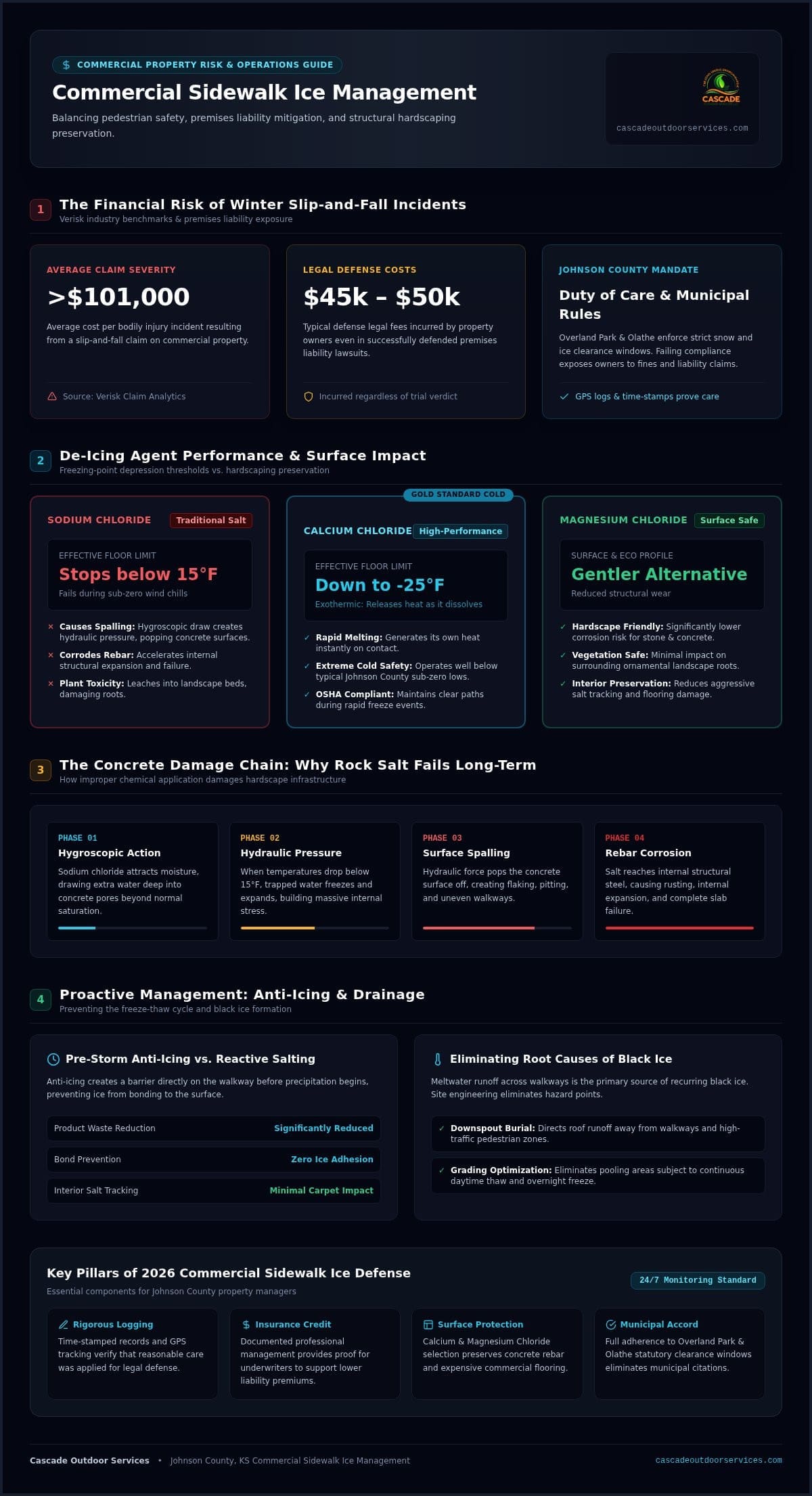
A single accident can be financially devastating. Data from Verisk indicates that the average bodily injury claim severity has climbed to over $101,000. Even if you win a case, the legal defense fees alone often range between $45,000 and $50,000. Professional sidewalk ice management for businesses mitigates this risk by establishing a rigorous paper trail. We use time-stamped logs and GPS tracking to prove that “reasonable care” was taken. These records are your primary defense in court, showing exactly when de-icing and anti-icing techniques were applied. This level of diligence can also lead to lower insurance premiums, as providers recognize the reduced risk profile of a professionally managed site.
Protecting the “Extension of Your Interior”
Your sidewalk is the handshake of your business. It’s the first thing a client touches before they enter your building. We view the exterior environment as a vital extension of your interior space; a clear, dry walkway signals discipline and attention to detail. Beyond aesthetics, professional management prevents the “salt tracking” that destroys expensive commercial carpets and pitts stone flooring. By using the right products at the right times, we ensure your entryway remains a polished environment rather than a slushy, corrosive mess. This proactive stance is often linked to the long-term health of your property’s grading and drainage systems, preventing meltwater from refreezing and creating hazardous “black ice” patches that damage both your reputation and your hardscaping assets.
Choosing the Right De-icing Agents for Commercial Surfaces
Effective sidewalk ice management for businesses begins with a basic understanding of freezing-point depression. When a de-icing agent dissolves into the moisture on a walkway, it creates a brine that lowers the temperature at which water turns to ice. While rock salt is the most common tool in the industry, it’s often the least effective for the specific needs of a commercial property in Johnson County. Traditional rock salt stops working effectively once temperatures dip below 15 degrees Fahrenheit. In our region, sub-zero wind chills and overnight freezes are common, requiring a more sophisticated approach to chemical selection that balances melting speed with the preservation of your hardscaping.
The Impact of Sodium Chloride on Infrastructure
Sodium chloride, or rock salt, is notoriously aggressive toward structural materials. It accelerates the corrosion of the steel rebar buried inside your concrete sidewalks, leading to internal expansion and eventual structural failure. Beyond the hidden damage, salt causes “spalling,” which is the unsightly flaking and pitting of the concrete surface. This happens because salt is hygroscopic; it attracts more water into the concrete’s pores. When that extra water freezes, the resulting hydraulic pressure is strong enough to pop the surface of the concrete off. This salt also leaches into the surrounding soil, dehydrating your landscape beds and damaging the root systems of expensive ornamental plants.
High-Performance Alternatives: Calcium and Magnesium Chloride
To maintain a safe environment and follow OSHA winter weather safety guidance, you need products that perform when the mercury drops. We focus on high-performance alternatives that protect your investment:
- Calcium Chloride: This is the gold standard for extreme cold. It’s an exothermic agent, meaning it releases heat as it dissolves, allowing it to melt ice at temperatures as low as -25 degrees Fahrenheit.
- Magnesium Chloride: A safer alternative for properties with heavy foot traffic or sensitive vegetation. It’s less corrosive than salt and works effectively down to -13 degrees Fahrenheit.
- Potassium Acetate: Often applied as a liquid, this non-chloride agent is biodegradable and non-corrosive, making it the premier choice for natural stone and high-end pavers.
A craftsman’s approach to sidewalk ice management for businesses involves choosing the specific agent that matches your property’s unique materials. Whether you have natural stone entries or standard concrete paths, the goal is perennial reliability without the structural decay caused by cheap alternatives. If you’re ready to upgrade your property’s winter defense, we invite you to explore our commercial maintenance services to see how we protect Johnson County assets.
Proactive vs. Reactive Sidewalk Maintenance Strategies
Most property owners approach winter weather with a “wait and see” mindset. This reactive strategy is inherently flawed. When you wait for snow to accumulate before acting, you’re forced to melt ice from the top down. This requires significantly more chemical product and labor, often leading to thick, compacted ice packs that are nearly impossible to clear completely. Professional sidewalk ice management for businesses relies on a proactive framework. By shifting the focus to prevention, we ensure your walkways remain clear while using 30% to 50% less salt. This isn’t just about efficiency; it’s about maintaining a “zero-tolerance” safety standard for high-traffic retail and office zones where even a small patch of ice is unacceptable.
Pre-Treatment and Brining Techniques
The secret to effective prevention lies in the science of the bond. When snow falls on untreated pavement, it bonds to the surface at a molecular level, creating a dangerous slip hazard. Anti-icing involves applying a liquid brine solution to dry pavement up to 12 hours before a storm hits. This creates a non-stick barrier that prevents the ice-to-pavement bond from ever forming. Utilizing watershed-friendly deicing strategies through precise liquid application reduces the total chloride load on your property. It’s a cleaner, more disciplined approach that keeps snow in a plowable state rather than letting it turn into a frozen sheet of black ice.
24/7 Weather Monitoring and Rapid Response
Timing is everything in Johnson County. A storm that hits at 3:00 AM requires a different response than one that arrives during the lunch rush. We utilize site-specific weather tracking to ensure our crews are staged and ready before the first flake falls. This rapid response is critical for beating the morning commute, ensuring your tenants and customers arrive at a safe, clear property. Our monitoring doesn’t stop when the snow ends. We stay on-site to watch for the “refreeze” cycle common in Kansas, where melting snow during the day turns back into ice as temperatures drop at night. This is where professional grading and drainage services become vital; if your property doesn’t move water away from walkways effectively, you’ll be fighting recurring ice patches all winter long. We provide the perennial reliability you need to focus on your business while we handle the rugged realities of the weather.
Preserving Infrastructure: Ice Management and Drainage
In the heart of Kansas, the transition from a sunny 40-degree afternoon to a 10-degree night is a common occurrence. This rapid temperature swing fuels the “Freeze-Thaw” cycle, a destructive force that ruins concrete and stone. Effective sidewalk ice management for businesses requires a deep understanding of how water moves across your property. If your drainage is poor, you aren’t just fighting snow; you’re fighting the very ground beneath your feet. Poorly routed meltwater from eaves and downspouts is the primary cause of black ice, often leading to increased liability when water crosses pedestrian walkways and refreezes overnight.
When meltwater isn’t channeled away, it seeps into the sub-base of your sidewalks. As night falls and the water freezes, it expands with incredible force, causing the concrete to heave and crack. This creates trip hazards and pockets where more water can pool, worsening the cycle every season. Our team uses structural expertise to integrate French drains and catch basins, ensuring that meltwater has a clear path away from your pedestrian zones. This craftsman’s approach addresses the root cause of ice formation rather than just treating the symptoms.
Identifying Drainage Issues Before Winter Hits
Finding “low spots” is the first step in a proactive winter plan. These areas act as reservoirs for meltwater, turning into treacherous black ice the moment the sun sets during a typical JoCo freeze. A critical move for any business is ensuring downspouts don’t dump water directly onto walkways. We specialize in grading and drainage services that bury these lines, moving water safely underground. This simple structural shift eliminates the most common cause of recurring ice patches before the first winter storm arrives.
Structural Longevity and Property Value
Professional maintenance is an investment in your property’s lifespan. Constant exposure to salt spray and hydrostatic pressure from trapped water can degrade adjacent retaining walls and hardscaping. By managing ice through a lens of structural health, you prevent the need for premature and expensive sidewalk replacement. In the world of commercial real estate, a well-maintained exterior isn’t just about curb appeal; it’s a marker of property value and operational excellence. Protecting these assets from the corrosive effects of poorly managed ice ensures your property remains a polished, safe environment for years to come.
Don’t let poor drainage compromise your safety this winter. Contact us for a professional drainage assessment to protect your property’s infrastructure today.
Securing a Commercial Snow and Ice Contract for 2026
Reliability in winter weather is the result of disciplined procurement. Industry standards, specifically the ANSI-accredited SIMA-10-2025, suggest that commercial property contracts be awarded no later than September 1. By the time the first frost hits, most professional route capacities are already closed for the season. For Johnson County property managers, early booking ensures your site is a priority rather than an afterthought during a major storm event. Securing sidewalk ice management for businesses during the late summer months allows for a measured, methodical approach to planning that reactive, last-minute hiring simply cannot match.
Billing structures typically fall into two categories: Per-Event or Seasonal Retainer. A Per-Event model offers flexibility, where you pay based on the frequency and intensity of winter storms. This is often preferred by properties with lower traffic volumes. Conversely, a Seasonal Retainer provides a fixed cost for the entire winter, offering budget certainty regardless of how many blizzards hit the region. Each model has its merits, and the right choice depends on your specific risk tolerance and operational goals for the 2026 season.
Evaluating Your Service Provider
When selecting a partner, look beyond the price tag. A dependable provider must possess commercial-grade equipment and comprehensive insurance coverage tailored for high-liability environments. Local ownership is a significant advantage in Johnson County. A local team understands the unique terrain and micro-climates of Overland Park and Olathe, and they won’t be sidelined by travel delays from distant headquarters. Ensure your provider offers site-specific safety plans and clear emergency contact protocols so you’re never left wondering when your crew will arrive during a midnight freeze.
Next Steps: Requesting a Property Evaluation
The most effective contracts are built on a foundation of site-specific knowledge. A pre-winter walkthrough allows us to identify potential hazards like hidden low spots or drainage issues that we discussed in previous sections. During this evaluation, we define “trigger depths” for service and establish priority zones for clearing. This ensures that your most critical pedestrian routes are addressed first, maintaining compliance with local ordinances and federal ADA standards. Taking these steps now creates a steady, purposeful plan for the season ahead. Schedule your 2026 commercial snow and ice evaluation to ensure your property remains a safe, polished environment all winter long.
Mastering Your Property’s Winter Resilience
Your property is a significant investment; every winter storm shouldn’t be a source of anxiety. We’ve explored how a craftsman’s approach to sidewalk ice management for businesses balances immediate pedestrian safety with the long-term structural health of your hardscaping. By choosing surface-safe de-icing solutions and addressing root-cause drainage issues, you prevent the pitting and heaving that leads to expensive, premature replacements.
Success in 2026 relies on a proactive partnership. Our team provides the perennial reliability of 24/7 weather monitoring and site-specific safety plans, ensuring your walkways are clear before your first tenant or customer arrives. This disciplined strategy moves your maintenance from a reactive scramble to a polished, predictable environment. Don’t wait for the first freeze to realize your plan is incomplete. Secure the peace of mind that comes from professional expertise and local Johnson County trust.
Secure Your Commercial Snow and Ice Contract for 2026
We look forward to helping you maintain a safe, beautiful environment through every seasonal transition.
Frequently Asked Questions
Is salting sidewalks before it snows actually effective?
Pre-treating walkways with a brine or granular agent before a storm is highly effective. This process, known as anti-icing, creates a non-stick barrier that prevents snow and ice from bonding to the pavement surface. It’s a core component of sidewalk ice management for businesses because it makes mechanical removal much easier. Without this bond, snow doesn’t turn into a compacted ice sheet, allowing for a safer, drier surface with less chemical usage overall.
What is the safest de-icer to use on new concrete sidewalks?
For concrete sidewalks less than one year old, the safest approach is to avoid aggressive chloride-based chemicals like rock salt or calcium chloride. These agents can cause chemical spalling and increase freeze-thaw pressure in “green” concrete. Instead, we recommend using sand for traction or premium, non-corrosive alternatives like Calcium Magnesium Acetate (CMA). These products protect the structural integrity of your new hardscaping while still providing necessary pedestrian safety during a Johnson County freeze.
How soon after a snowstorm must a business clear its sidewalks in Johnson County?
Local ordinances in Johnson County typically require snow removal within 24 to 48 hours after a storm concludes. For example, cities like Overland Park and Olathe have specific triggers for enforcement. However, for most commercial properties, the standard is much higher. A professional service level agreement usually dictates that walkways must be clear before business hours begin. This proactive timeline is essential to meet your legal duty of care and avoid potential slip-and-fall litigation.
Does professional ice management help reduce my business insurance premiums?
Many insurance providers recognize the reduced risk profile of properties that utilize professional sidewalk ice management for businesses. By maintaining site-specific safety plans and detailed application logs, you provide a robust defense against premises liability claims. This documented “reasonable care” is a significant factor in risk assessment. While you should consult your specific agent, a certified snow management contract is often viewed as a proactive step that can lead to more favorable premium rates.
Will de-icing salt damage my building’s structural timber or retaining walls?
Standard rock salt is highly corrosive to both wood and stone. Over time, salt spray can dehydrate timber retaining walls, leading to premature rot and structural failure. It also causes efflorescence and surface pitting on segmental block or natural stone walls. Our team specializes in structural hardscaping, so we prioritize surface-safe solutions that protect your property’s assets. Using the right chemical balance ensures your walkways are safe without compromising the longevity of your expensive outdoor structures.
What is “black ice” and how do professionals prevent it on commercial properties?
Black ice is a transparent layer of glaze that forms when meltwater refreezes on a surface, often appearing as wet pavement. Professionals prevent this through a combination of anti-icing brines and structural drainage improvements. By burying downspouts and ensuring proper grading, we remove the water source that causes black ice to form. Continuous 24/7 monitoring allows our crews to identify and treat refreeze areas during the fluctuating temperature cycles common in Kansas winters.
What is the difference between anti-icing and de-icing?
Anti-icing is a proactive strategy where chemicals are applied before a storm to prevent ice from bonding to the pavement. De-icing is a reactive process used to melt snow and ice that has already accumulated. While both are necessary, anti-icing is far more efficient. It requires about one-fourth the amount of chemical product compared to de-icing, making it a more environmentally friendly and cost-effective way to maintain safe walking surfaces throughout the winter.