
What if the best way to protect your yard isn’t to patch a failing retaining wall, but to understand why it’s failing first? A timber retaining wall replacement can affect more than the wall itself, especially when shifting soil or poor drainage puts nearby landscaping and outdoor features at risk.
If your wall is leaning, bulging, rotting, or separating at the joints, it’s reasonable to wonder whether a repair will hold or a full rebuild makes more sense. The answer depends on the extent of the damage, the surrounding soil, and how water moves through the site. Replacing the structure without addressing the cause of the damage can leave the same problem in place beneath the new materials.
This guide explains signs that call for a closer assessment, factors that help distinguish repair from replacement, and choices such as timber, segmental block, or natural stone. It also covers drainage planning and what to consider during construction, so you can make a practical plan for your property. Cascade Outdoor Services serves Johnson County, Kansas, including Overland Park, Olathe, Leawood, Lenexa, Shawnee, and Prairie Village.
Key Takeaways
- Rot, leaning, separated timbers, and shifting ground are signs to examine. Visible deterioration alone doesn’t confirm that a full rebuild is needed.
- A timber retaining wall replacement starts with assessing the site and understanding how the wall, grade, access, and drainage affect the project.
- Timber, segmental block, and natural stone offer different looks and may suit different property conditions and goals.
- Prepare by noting changes around the wall, nearby features, and access points that could shape the work.
- Cascade Outdoor Services plans retaining wall projects around the property and its needs for homeowners across Johnson County, Kansas.
Does a failing timber retaining wall need replacement?
Visible deterioration can signal a problem, but it doesn’t by itself confirm that the whole wall needs replacement. The decision depends on how extensive the damage is, whether the wall is moving, and what’s happening to the soil and landscape around it.
Inspect the full length of the wall rather than focusing on one damaged timber or mark. Note soft or visibly decayed areas, leaning or bulging sections, widening gaps, and pieces that appear displaced. Look at the ground above and below the wall, too: soil collecting at the base, a slope that appears to be shifting, or settled landscaping can help describe what has changed.
These observations help explain the problem, but they don’t identify its cause on their own. A retaining wall holds back soil, and its form and function can vary, as outlined in this overview of retaining wall types and functions. Both the wall’s condition and the surrounding site matter when deciding what work is appropriate.
What signs suggest a timber retaining wall is deteriorating?
Soft or visibly decayed timber warrants attention, particularly when it appears across several sections or near areas where the wall is shifting. A surface blemish alone doesn’t establish that the structure has failed.
Look for patterns: a section leaning away from the slope, a bulge that changes the wall’s profile, widening gaps, or timbers no longer sitting in line. Check the ground above and below the wall as well. New depressions, displaced soil, or changes to nearby planting beds add useful context, but none proves a specific cause without a closer site assessment.
When might repair be different from replacement?
A repair may be appropriate when deterioration is localized, while widespread decay or movement across several sections can indicate a larger project. An on-site assessment helps determine the extent and pattern of the damage before defining the work.
One visibly damaged timber in an otherwise steady-looking wall presents a different situation from several separated timbers and a wall that has gradually leaned. Even then, appearance alone can’t confirm whether a repair will address the underlying issue. The surrounding soil, the wall’s overall alignment, and signs of movement all help shape the decision.
Persistent movement or decay across a timber retaining wall calls for an on-site assessment to identify the damage and determine whether repair or replacement is appropriate. Cascade Outdoor Services builds timber retaining walls and plans the work around the property’s conditions. Learn more about retaining wall services.
What happens during timber retaining wall replacement?
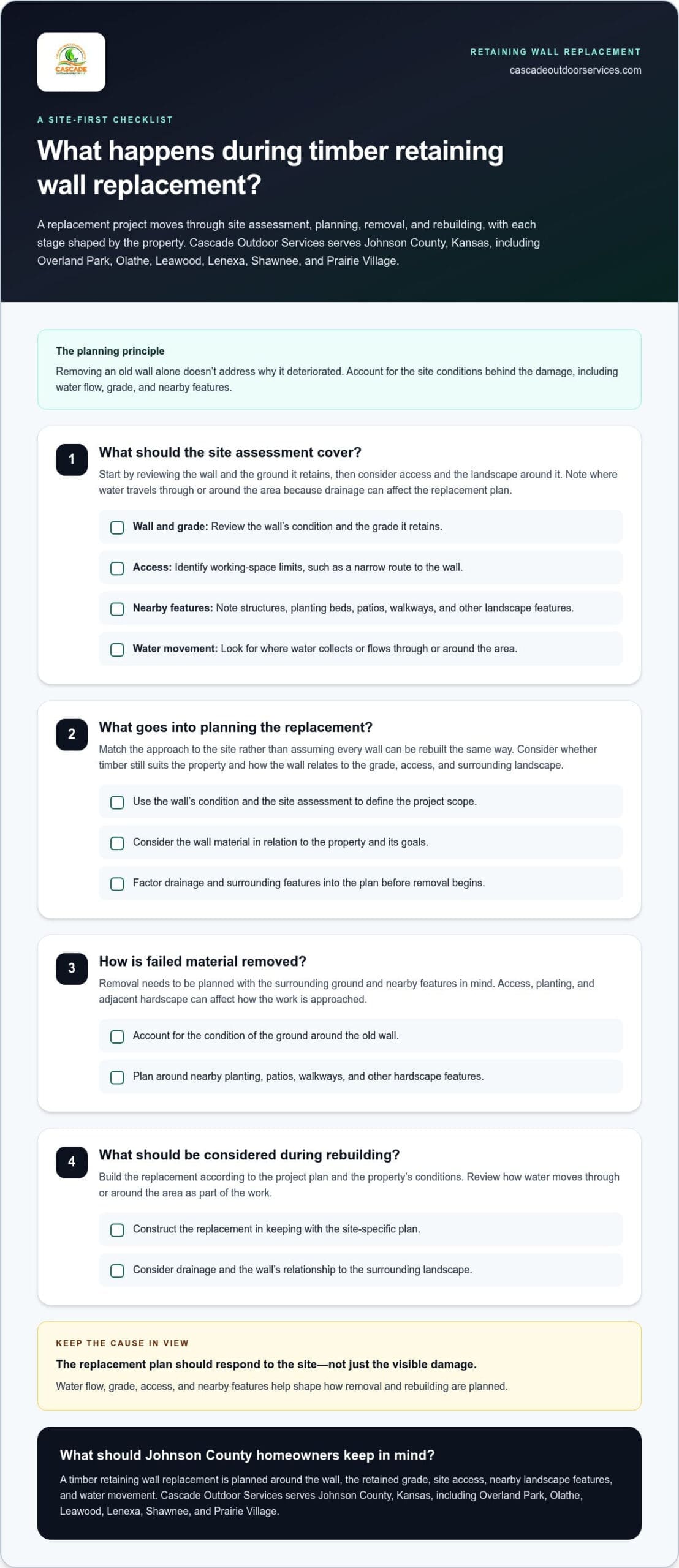
A timber retaining wall replacement involves assessing the site, planning the work, removing failed material, building the new wall, and considering drainage. The scope depends on the wall’s condition, access, grade, and surrounding landscape, so the plan should reflect the specific property.
Each stage informs the next. Rather than assuming every wall can be removed and rebuilt in the same way, plan around the site as it is and the conditions that contributed to the damage.
- Assess the site: Review the wall, retained grade, access, nearby structures, landscape features, and signs of water movement.
- Plan the replacement: Match the approach to the site and consider whether timber still suits the property. Homeowners comparing options can review this overview of retaining wall materials.
- Remove failed material: Plan removal with the surrounding ground and nearby features in mind.
- Build and review: Construct the replacement and consider how water moves through or around the area.
Removing an old wall alone doesn’t address why it deteriorated; the replacement plan also needs to account for the site conditions behind the damage. Water flow, grade, and the wall’s relationship to nearby features can all affect the plan.
How is the site assessed before the old wall is removed?
A site assessment considers the wall’s condition, the grade it retains, access for the work, nearby structures, and existing landscape features. It also considers where water travels through or around the area, because drainage can affect how the replacement is planned.
For example, a narrow access route or planting beds close to the wall may influence how the work is approached. Noting where water collects or flows brings drainage into the planning process early. For related site work, Cascade provides grading and drainage services.
What should homeowners expect during removal and rebuilding?
Removal and rebuilding are key project stages, but their scope varies with site conditions. Nearby planting, patios, walkways, and other hardscape features can affect how the work is planned and how the surrounding landscape is handled.
Some sites have straightforward access to the wall, while others have tighter working space or nearby features to account for. The order and extent of tasks can vary, so there is no single sequence for every property. A project-specific assessment helps define the work and how drainage fits into the replacement.
How should you compare timber with other retaining wall options?
Timber, segmental block, and natural stone can each suit a retaining wall project, but they create different looks and support different property goals. Choose by considering the wall’s role, the surrounding landscape, and site conditions such as grade and access.
Start with how the replacement will relate to nearby outdoor features. Timber may suit a landscape where a wood appearance feels at home, while segmental block creates a more defined, modular look and natural stone brings varied shapes and textures. These are differences in appearance, not a ranking of which material is best.
What should guide a choice between timber, block, and stone?
Weigh the desired appearance alongside the wall’s function and the conditions on site. Existing patios, paths, planting, grade, and access can all affect how each option fits the property.
Compare the whole outdoor space, not just the wall’s face. A homeowner seeking a consistent, structured look may weigh the options differently from someone who wants the wall to blend with natural landscape features. The retained grade and practical access for construction also belong in the discussion. Cascade builds timber, segmental block, and natural stone retaining walls, with each project planned around the property and its needs.
| Material | Appearance to consider | Questions for the project |
|---|---|---|
| Timber | A wood finish can complement other natural outdoor elements. | Does timber suit the landscape and the wall’s intended role? |
| Segmental block | Individual units create a more regular, defined pattern. | Would that look work with nearby hardscape and the site’s grade? |
| Natural stone | Stone pieces can bring variation in shape and surface. | Does that character fit the surrounding landscape and project goals? |
Use the comparison to clarify priorities rather than choosing by appearance alone. For broader background on comparing retaining wall materials, consider how each option relates to the specific site and the effect you want in the finished landscape.
How does water management affect replacement planning?
Water movement around the wall is part of planning a replacement, whatever material you choose. Considering where water travels helps address the site conditions as well as the visible wall.
Notice whether runoff approaches from higher ground, passes near the wall, or affects nearby planting and hardscape. These observations help shape drainage planning. Replacing the visible timbers without considering water movement may leave an important site condition out of the plan. Cascade’s yard drainage services address related grading and drainage needs as part of outdoor site planning.
A thoughtful timber retaining wall replacement balances appearance, function, and the property’s conditions. In Johnson County, the right material choice starts with those priorities, not a universal ranking.
How can Johnson County homeowners prepare for a wall replacement?
Before a timber retaining wall replacement, note the wall’s visible condition, nearby features, and routes that could provide access to the work area. These details give a clearer picture of the property while leaving the project plan open to the site’s actual conditions.
Properties across Johnson County differ in grade, soil, drainage, and landscape layout, so preparation is about recording what you can see, not assuming every site needs the same approach. Whether your home is in Overland Park, Olathe, Leawood, Lenexa, Shawnee, or Prairie Village, start with a brief site checklist.
- Wall condition: Note visible leaning, decay, separated timbers, or sections that appear displaced.
- Nearby features: List patios, planting beds, walkways, structures, and other elements close to the wall.
- Access: Identify possible routes to the work area and any narrow passages or obstacles.
- Yard changes: Record noticeable changes in the adjoining ground or landscape.
What information helps describe the wall and its surroundings?
Describe what you can observe along the full wall and in the nearby yard, including leaning, decay, gaps between timbers, and changes to adjoining soil or landscaping. Include nearby patios, planting beds, walkways, and structures so the wall can be considered in context.
Photos from several angles can help document these observations and show how the wall relates to the rest of the yard. They provide useful context, but they don’t replace an assessment at the property. A photo may show a leaning section, for example, while the surrounding grade and access still need to be considered in person.
How can you plan around landscaping and access?
Map out routes to the wall and note landscape features that could shape how the work is planned. Whether nearby elements need protection or adjustment depends on the property and project conditions.
Consider how close the work area is to planting, hardscape, and structures, and identify features you want to preserve. A narrow side yard, a walkway beside the wall, or established planting beds can all affect the approach. Share these details early so they can be considered alongside the wall’s condition and the site layout.
Timing and disruption depend on the scope and surroundings, so don’t assume every property follows the same schedule. Homeowners looking for more structural context can review the retaining wall services overview to learn about Cascade’s work. A site-specific plan brings the visible wall, access, and surrounding landscape together in one practical project.
How does Cascade Outdoor Services approach timber wall replacement?
Cascade Outdoor Services plans retaining wall work around the property, the wall’s condition, and the project’s needs. As a locally owned company focused on hardscaping and structural outdoor construction, Cascade considers the wall and its surrounding site together.
What makes a replacement plan specific to the property?
Wall condition, site layout, access, and drainage all help shape a replacement plan. Cascade builds timber, segmental block, and natural stone retaining walls, so material decisions can be considered alongside the property’s needs.
A wall bordering a planting bed may present different planning considerations from one beside a walkway or near a structure. The available access and the grade the wall retains also help define the setting. A replacement is not only a choice of material; it is construction within a particular outdoor space.
Drainage belongs in the conversation, too. Water moving through or around the site can affect how the project is planned, especially when grading or other drainage needs are part of the surrounding conditions. Cascade considers retaining wall work alongside relevant grading and drainage needs, with the approach based on the property.
This property-focused approach keeps decisions grounded in what is visible at the site. It also gives homeowners a chance to discuss the wall’s purpose, the condition that prompted the project, and how the finished area should relate to nearby landscape features.
What is the next step for a Johnson County wall?
Start by describing the wall’s visible condition and the features around it. A project conversation can help frame the site details and the questions to consider before choosing a material or defining the work.
Share where the wall sits in the yard, what is nearby, and whether the surrounding ground or landscape has changed. Those details provide context for discussing the property rather than treating replacement as a standard rebuild. The goal is to understand the wall’s role and setting before settling on a direction.
Cascade serves homeowners in Johnson County, including Overland Park, Olathe, Leawood, Lenexa, Shawnee, and Prairie Village. Explore Cascade’s retaining wall and hardscaping services to start planning for your wall and the surrounding site.
For a lasting timber retaining wall replacement, begin with an assessment of the wall and its property conditions, then weigh material and project choices in that context. This practical first step helps homeowners make informed decisions for their Johnson County outdoor space.
What’s the next step for your retaining wall?
A timber retaining wall replacement is a chance to make a considered decision for the space, not just choose new materials. Start with what you want the area to do and how the wall fits into the yard, then use an on-site assessment to guide the project direction.
For homeowners in Johnson County, Kansas, the next step is a conversation about the wall and its surroundings. Cascade Outdoor Services serves Overland Park, Olathe, Leawood, Lenexa, Shawnee, and Prairie Village, providing retaining wall and drainage services planned around property needs.
Bring forward the details that matter to you, whether that’s access, nearby landscaping, or how the finished wall should relate to the rest of your outdoor space. A clear view of the site helps move the conversation toward a practical plan.
Explore Cascade’s retaining wall and hardscaping services to plan your next step.
Frequently Asked Questions
How long does it take to replace a timber retaining wall?
The duration depends on the wall and the conditions around it, so it is determined for the specific project rather than assumed in advance. Limited access, nearby hardscape, or landscape features to work around can affect the work. Share access constraints and nearby features during project planning so they can be considered when discussing the scope.
Can old timbers be reused in a retaining wall replacement?
Old timbers should only be considered for reuse after their condition and suitability have been assessed. A piece that looks intact on the exposed face may have deterioration elsewhere, and the demands on a retaining wall differ from those on decorative landscape elements. Don’t assume salvaged timbers are appropriate for structural use; their condition, intended role, and fit with the replacement plan all need consideration.
Can a retaining wall be replaced without disturbing nearby landscaping?
Some nearby landscaping may be possible to retain, but a replacement can’t be planned on the assumption that nothing around the wall will be affected. Access, the wall’s position, and the work area help determine what can stay in place. Identify features you’d like to preserve, such as a favorite shrub or a path, so they can be considered as part of the project.
Is winter a suitable time to replace a timber retaining wall?
Winter may suit some replacement projects, but the answer depends on the site and conditions during the planned work. Weather and the state of the ground can affect access and how outdoor construction proceeds, so the season alone can’t determine whether a project is appropriate. For a Johnson County property, discuss the wall’s condition and site access when considering a project window.
Can a timber retaining wall be replaced with stone or block?
Yes, timber can be replaced with natural stone or segmental block if the choice suits the wall’s purpose and the property. Consider the new material in relation to the grade, layout, access, and surrounding landscape, not appearance alone. Homeowners updating other hardscape may want the replacement wall to complement those features. Cascade Outdoor Services builds timber, segmental block, and natural stone retaining walls.
What should I do if a retaining wall starts leaning?
If a retaining wall starts leaning, document the change and arrange an assessment rather than trying to push it back or make an improvised repair. Take photos from a consistent viewpoint and note whether the lean appears to be changing, along with any new gaps or nearby movement. If you’re concerned about the wall’s stability, keep people and stored items away from the affected area and describe what you’ve observed during the assessment.
Does a retaining wall replacement require changes to the surrounding yard?
Not every replacement requires the same yard changes; the scope depends on how the wall fits into the site and what needs to be addressed during the work. A planting bed directly beside the wall may need adjustments, while a distant lawn area may not be part of the project. Johnson County site conditions vary, so consider the wall and adjacent features together when planning restoration.