
The first five months of 2026 have been the 9th wettest in the last 132 years for Johnson County, leaving many local homeowners struggling with standing water that simply won’t disappear. If you’ve spent the spring cleaning muddy paws or watching your lawn turn into a swamp, you know that our regional soil doesn’t play fair. It’s exhausting to worry about basement leaks or foundation damage every time a heavy storm rolls through Overland Park or Olathe. You’ve likely realized that a simple patch of grass isn’t enough to handle the unique challenges of “JoCo Clay.”
You deserve a property that stays dry and functional, regardless of how much rain falls. This guide will help you discover professional backyard drainage solutions for clay soil that are specifically designed for the Kansas landscape. We’ll show you how to transform your waterlogged yard into a protected, usable space using proven strategies like French drains, catch basins, and strategic grading. We will walk through the essential steps of sub-surface filtration and structural improvements to ensure your home remains safe and your backyard stays beautiful for the long term.
Key Takeaways
- Understand how the unique structure of Kansas clay soil traps water and creates hydrostatic pressure against your home’s foundation.
- Identify the most reliable backyard drainage solutions for clay soil, including the strategic use of French drains and catch basins to manage both surface and sub-surface water.
- Learn how professional grading and retaining walls work together to permanently redirect runoff and fix problematic low spots in your landscape.
- Discover the essential design adjustments needed to protect your drainage system from the local freeze-thaw cycle and heavy spring rainfall.
- Recognize the importance of precision tools like laser-leveling to ensure your drainage pipes maintain the proper slope for long-term reliability.
The Challenge of Backyard Drainage Solutions for Clay Soil
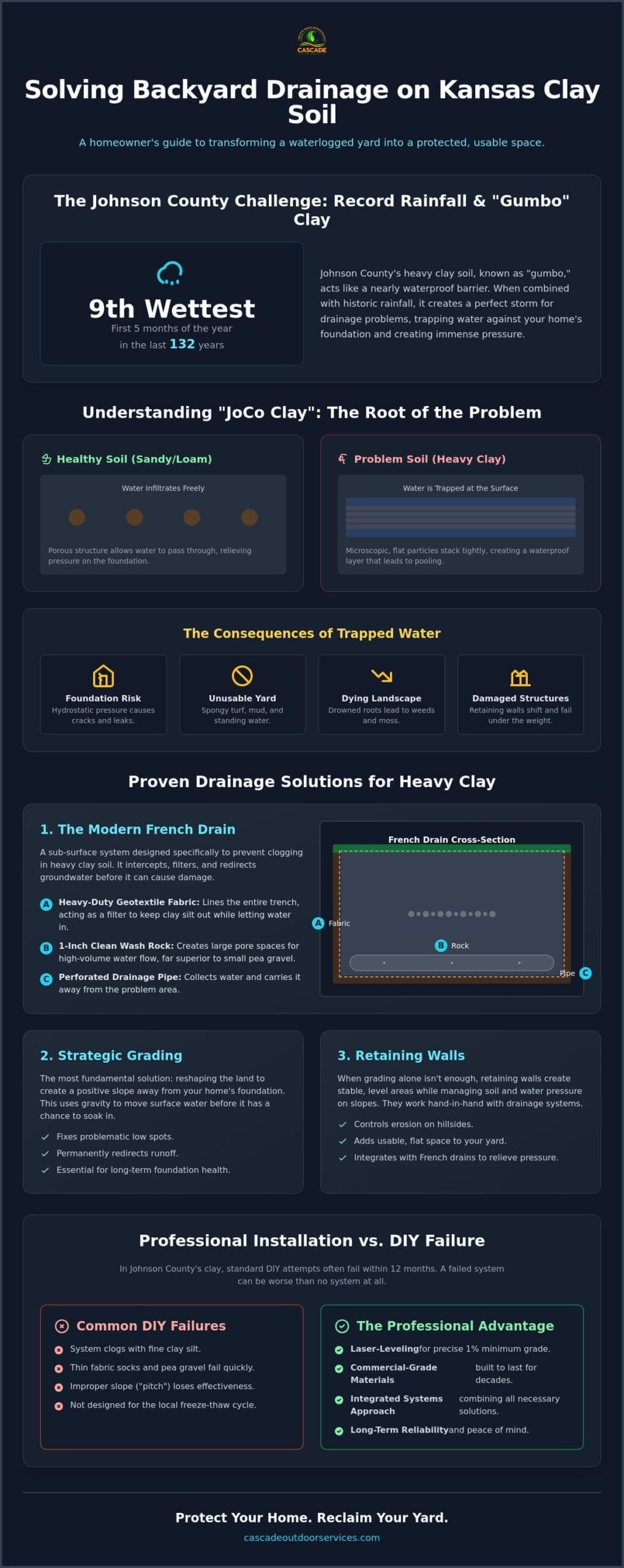
Johnson County homeowners often deal with “gumbo,” a heavy clay that behaves more like a sponge than a filter. Unlike sandy soils that allow water to pass through easily, clay particles are microscopic and flat, stacking together like wet sheets of paper. This creates a nearly waterproof barrier that resists natural infiltration. When heavy Kansas rains hit, the water has nowhere to go. It sits on the surface or saturates the top few inches, creating a muddy mess that can last for days after the clouds clear. Finding effective backyard drainage solutions for clay soil requires more than just digging a hole; it requires an understanding of how our local earth reacts to moisture.
Why Clay Soil Stays Wet
Many properties in Overland Park and Olathe suffer from what’s known as the “bowl effect.” During the home-building process, contractors excavate a large area for the foundation and then backfill that space with looser soil. This backfill is surrounded by dense, undisturbed native clay. This creates a literal bowl where water collects right next to your home’s most vulnerable structure. Because clay holds water so tightly, it doesn’t take much rain to reach a point of total saturation. Once the soil is full, every additional drop of rain becomes runoff, pooling in low spots or flowing toward your foundation.
The Consequences of Poor Drainage
Trapped water is incredibly heavy. As clay saturates, it expands and exerts hydrostatic pressure against your basement walls and grading and drainage services in Johnson County are often needed to relieve this force. This pressure can cause concrete to bow, shift, or develop hairline cracks that eventually lead to leaks. Beyond the foundation, poor drainage ruins the lifestyle benefits of your yard. You might notice these common signs of failure:
- Spongy turf that stays wet days after a storm.
- Moss growth in shaded areas where grass has died off.
- Standing water that “drowns” grass roots, leading to thinning lawns and aggressive weed growth.
- Shifting or leaning timber retaining walls caused by the weight of water-logged soil behind them.
If you’ve researched What is a French Drain?, you know it’s a primary tool for moving this trapped water. However, standard DIY attempts often fail in Johnson County within the first 12 months. Without professional-grade fabric, specific gravel types, and precise laser-leveling, these systems quickly clog with fine clay silt or lose their pitch. A failed system is often worse than no system at all, as it can concentrate water in areas where it does the most damage. True backyard drainage solutions for clay soil must be built to withstand the unique physical properties of the Kansas landscape.
Top Backyard Drainage Solutions for Heavy Clay
Managing water in a clay-heavy landscape requires a multi-layered strategy that addresses both surface runoff and sub-surface saturation. In Johnson County, we can’t rely on the soil to do the work for us. Instead, we must create a dedicated path for water to exit the property before it has a chance to turn your lawn into a bog. The most effective backyard drainage solutions for clay soil combine high-capacity collection points with filtered underground channels to ensure long-term performance.
The Modern French Drain for Clay
While the concept of a French drain is simple, the execution in clay soil must be precise to avoid failure. Standard DIY kits often use thin socks or pea gravel that clog with fine clay particles within a single season. To prevent this, we use a heavy-duty non-woven geotextile fabric to line the entire trench. This fabric acts as a professional-grade filter, allowing water through while keeping the “gumbo” out of your drainage system.
- Clean Aggregate: We utilize 1-inch clean wash rock rather than pea gravel. The larger stones provide significantly more pore space, allowing water to move rapidly toward the pipe.
- Precise Pitch: In heavy soil, a 1% minimum grade is non-negotiable. This ensures that even during a light drizzle, water maintains enough velocity to carry away any sediment that might enter the system.
- Durability: By wrapping the pipe and rock together in a “burrito” of filter fabric, we create a system that remains clear for decades.
Surface Collection Systems
Sometimes the water moves too fast for a French drain to catch it all. For those low spots in your yard that resemble small ponds after a JoCo thunderstorm, catch basins and grates are essential. These basins act as localized “drains” that take in large volumes of surface water and direct it into a solid-wall pipe system. This bypasses the clay soil entirely, moving the water to a safe exit point at the curb or a designated rain garden.
Another critical component is downspout burial and extension. Your roof collects a massive amount of water; allowing it to dump directly onto the clay near your foundation is a recipe for disaster. We connect these downspouts to the same solid-wall system, ensuring roof runoff never touches your backyard. To keep these systems running smoothly, it’s a good idea to check your grates during your regular property maintenance to clear away grass clippings or fallen leaves that can block the flow.
For areas with steep slopes or high-velocity runoff, a dry creek bed offers a beautiful way to manage water. By using a mix of river rock and larger boulders, we can create a functional channel that looks like a natural landscape feature while protecting your soil from erosion. If you’re tired of a soggy yard, exploring professional grading and drainage services in Johnson County can provide a permanent path to a dry landscape.
Integrating Grading and Retaining Walls for Structural Drainage
While French drains and catch basins handle the water once it’s on the move, the physical shape of your land determines where it goes in the first place. Professional grading is the foundation of all effective backyard drainage solutions for clay soil. By altering the “topography of trouble,” we can steer runoff away from low spots before it has a chance to saturate the subsoil. In Johnson County, where the clay can hold moisture for weeks, relying on gravity alone without a clear plan is a recipe for a swampy yard.
Professional Grading Strategies
We use swales and berms to manipulate the landscape’s natural flow. A swale is a shallow, wide channel lined with turf or rock that acts as a natural highway for rainwater. Conversely, berms are subtle mounds that block water from entering sensitive areas, such as a patio or a basement window well. The most critical aspect of this work is establishing positive grading. This means ensuring the first 10 feet of soil surrounding your foundation slopes away at a minimum 5% grade. If your yard has negative grading, water will naturally flow toward your home, putting immense pressure on your foundation walls. For a precise evaluation of your property’s pitch, you can reach out to our team for Cascade Grading & Drainage Services.
Drainage-First Retaining Walls
Retaining walls are often viewed as purely aesthetic features, but in our region, they are vital water management tools. Whether we are installing timber retaining walls or segmental block systems, the structure must be engineered to handle the unique weight of wet Kansas clay. When clay saturates, it expands, creating massive hydrostatic pressure. Without a way for that water to escape, even the sturdiest wall will eventually tip or bow.
To prevent this, every wall we build includes an integrated drainage system. This starts with a thick layer of “clear gravel” backfill directly behind the wall. Unlike dirt, this gravel allows water to drop straight down to a perforated drainage pipe at the base of the wall. We also incorporate weep holes, which are small openings that allow trapped moisture to exit the front of the wall safely. This combination of structural integrity and fluid dynamics ensures your landscape remains stable and dry. If you need a long-term fix for a failing slope, consult an Expert Retaining Wall Contractor in Johnson County, KS who understands the specific demands of our local terrain. By integrating these structural elements, we provide backyard drainage solutions for clay soil that protect both your lawn and your home’s foundation.
Planning Your Drainage System for the Kansas Climate
Planning a system in Johnson County requires more than just a shovel and some pipe. Our local climate presents two major hurdles: the “Spring Gumbo” season and the relentless freeze-thaw cycle. With the first five months of 2026 ranking as the 9th wettest in 132 years, your backyard drainage solutions for clay soil must be built for extreme volume. If you bury a pipe only six inches deep, the winter frost can heave the line or create ice dams that render the system useless when you need it most during the spring thaw. We design for the worst-case scenario to ensure your investment survives every season.
Before any excavation begins, you must call 811 for a utility locate. Kansas One-Call is a non-negotiable first step to ensure you don’t strike gas, fiber optic, or water lines. Once the site is marked and the “topography of trouble” is understood, you can move into the structural planning phase.
Step-by-Step Planning Framework
- Identify the low point: Water always wins the fight with gravity. Watch your yard during a storm to see where the “pond” naturally forms; this is your primary collection area.
- Calculate the Run: Measure the linear distance from your collection point to a safe exit. This helps determine the volume of materials needed and ensures you can maintain the required 1% minimum pitch.
- Choose the exit strategy: You can “daylight” the pipe to a curb, use a pop-up emitter that opens only under water pressure, or direct the flow into a designated rain garden.
Material Selection for Longevity
The heavy clay in our region doesn’t just hold water; it exerts massive physical force as it expands and contracts. Thin-wall corrugated pipe, often found at big-box retailers, can easily crush under the weight of saturated JoCo clay. We recommend rigid PVC or heavy-duty, dual-wall corrugated pipe to ensure the channel remains open for decades. These materials provide the structural integrity required to withstand the pressure of shifting Kansas earth.
Avoid the “socked” pipe often marketed for DIY projects. In our fine-particle clay, these thin fabric sleeves clog almost instantly, turning your drain into a buried stick of mud. Instead, use a separate layer of non-woven geotextile fabric to line the entire trench. Geotextile fabric serves as a critical, permeable barrier that prevents fine clay particles from entering and clogging the drainage stone while still allowing water to pass through freely. Selecting the right components today prevents a total system failure tomorrow.
If you’re ready to stop the mud and protect your property, our team can design a custom system using these high-performance materials. Schedule a consultation for professional grading and drainage services in Johnson County to get it right the first time.
Professional Installation vs. DIY in Johnson County
While a weekend warrior might feel confident with a shovel, the heavy clay soil in Johnson County is notoriously unforgiving. A DIY drainage project often fails because it lacks the precision required to move water across our relatively flat regional landscape. “Eyeballing” the slope might work for a small garden bed, but for a 50-foot French drain, it leads to standing water trapped inside the pipe. This stagnant water eventually turns into a breeding ground for mosquitoes or clogs the system with fine sediment. When you’re dealing with the unique physical properties of “gumbo,” the margin for error is nearly zero.
We use laser-leveling technology to ensure every inch of the trench maintains the exact pitch needed for high-velocity flow. This accuracy is what keeps the system clear during the wettest Kansas months. Additionally, professional installation provides access to commercial-grade excavation equipment. These machines are designed to move massive amounts of heavy clay efficiently while minimizing the footprint on your existing lawn. A DIY rental often results in significant yard damage and a system that fails within the first year because it wasn’t buried deep enough to survive the freeze-thaw cycle.
Investing in professional backyard drainage solutions for clay soil is a strategic move for your home’s equity. With Johnson County residential property values projected to rise by an average of 5-7% in 2026, maintaining a dry foundation and a usable landscape is a vital financial investment. A professionally engineered system prevents the hydrostatic pressure that leads to five-figure foundation repairs, offering a much higher long-term ROI than a temporary fix. We treat your property with the same care we’d give our own neighbor, ensuring every pipe and basin is placed for maximum longevity.
The Cascade Difference
Our “Evaluation First” philosophy means we don’t just start digging. We analyze the entire property, including neighboring runoff, roof water volume, and existing landscape features. Whether you’re navigating strict HOA requirements in Overland Park or managing a steep, eroding backyard in Shawnee, we provide tailored solutions that look as good as they perform. You can explore our Cascade Services Overview to see how we integrate drainage with other structural outdoor solutions like retaining walls and lawn renovations.
Ready to Dry Out Your Backyard?
True peace of mind comes from knowing your yard can handle the wettest Kansas spring without turning into a swamp. We take pride in the heavy lifting and technical precision so you don’t have to, ensuring your backyard remains a dry, functional extension of your home. If you’re tired of tracking mud into the house and want a permanent solution, a professional site evaluation is the best way to begin. Contact Cascade Outdoor Services for a Drainage Consultation to start your property’s metamorphosis today. We have the right tools and the professional eye to get your backyard drainage solutions for clay soil done correctly the first time.
Invest in a Dry, Functional Landscape
A dry yard isn’t just a luxury for your pets and kids; it’s a structural necessity for your home’s foundation. You’ve seen how the unique density of Kansas clay requires more than a simple DIY trench. Effective backyard drainage solutions for clay soil demand an integrated approach that combines precision grading, heavy-duty filtration, and professional-grade materials. By addressing the root cause of standing water today, you’re protecting your property’s value and ensuring your outdoor space remains usable through the wettest spring seasons.
Cascade Outdoor Services has been locally owned and operated since 2016. We’ve spent nearly a decade specializing in the specific challenges of Johnson County clay soil management. Our team utilizes precision laser-leveled grading and structural integration to create systems that don’t just work for a season; they stand the test of time. We take pride in the physical labor and technical planning so you can simply enjoy a beautiful, dry environment. It’s time to reclaim your backyard from the mud and gain the peace of mind you deserve.
Protect Your Property with a Professional Drainage Solution and schedule your site evaluation today. We’re ready to help you transform your landscape into a durable, well-maintained retreat.
Frequently Asked Questions
Will a French drain get clogged by clay soil over time?
A French drain will only clog if it lacks a professional-grade non-woven geotextile fabric barrier. In Johnson County, the fine “gumbo” particles are small enough to migrate into the gravel and pipe without this protection. By wrapping the entire trench in fabric, you keep the clay out while allowing water to pass through freely. This ensures your backyard drainage solutions for clay soil remain clear and functional for decades.
How much slope does a backyard drainage pipe need to work?
A minimum 1% slope is necessary for water to flow effectively through a drainage system in heavy clay soil. This equates to roughly a 1-inch drop for every 8 feet of pipe. Without this precise pitch, water stays stagnant in the pipe, leading to sediment buildup and eventual system failure. We use laser-leveling tools to guarantee this accuracy across every project we install.
Can I use a dry creek bed instead of a buried drainage system?
Dry creek beds are excellent for managing high-velocity surface runoff, but they don’t address sub-surface saturation in clay. While they add a beautiful aesthetic element to your landscape, they work best when paired with a French drain or catch basins. This combination handles both the visible “ponds” and the invisible water trapped in the soil that often threatens your home’s foundation.
What is the best gravel to use for drainage in heavy clay?
Clean, 1-inch wash rock is the superior choice for drainage projects in our region. Unlike pea gravel, which is small and packs tightly, larger wash rock provides significant pore space for water to move rapidly toward the pipe. It’s also less likely to be displaced by heavy rainfall. Using clean aggregate ensures that no fine dust or dirt is introduced into the system during the installation process.
Do I need a permit for backyard drainage installation in Johnson County?
Permit requirements depend on your specific municipality and the scale of the work. In unincorporated Johnson County, a Land Disturbance Permit is required for projects disturbing more than one acre, which carries a $250 fee as of July 2026. Cities like Overland Park and Olathe have their own distinct fee schedules based on project valuation. It’s essential to verify local codes before starting any major grading or excavation.
For those in these unincorporated areas, proper drainage is also tied to the health of your septic field; you can discover Best Cistern Septic Solutions to see how professional inspections protect your property’s infrastructure during wet years like 2026.
How do I know if my wet yard is a grading problem or a soil problem?
Most drainage issues in Johnson County are a combination of both factors. If water pools in specific low spots, you likely have a grading problem that needs structural correction. However, if your entire lawn feels spongy for days after a storm, you’re dealing with the slow infiltration rates of clay soil. A professional evaluation helps determine if you need to reshape the land or install sub-surface pipes.
Can I connect my downspouts directly to my French drain?
You should never connect roof downspouts directly to a perforated French drain pipe. Doing so introduces too much water and debris into the sub-surface system, causing it to overflow and saturate the soil you’re trying to dry out. Instead, downspouts should be buried in a separate, solid-wall pipe system. This carries roof water directly to a safe exit point at the curb or a designated rain garden.
What happens to my drainage system during a Kansas winter freeze?
A properly installed system remains functional because the pipes are buried deep enough to avoid shifting and are pitched to prevent standing water from freezing inside. We design outlets with pop-up emitters or daylight exits to ensure ice doesn’t block the flow during the transition from winter to spring. Since early 2026 has been one of the wettest periods on record, having a freeze-resistant system is vital.
Water sitting in your yard after every storm?
Cascade Outdoor Services corrects grading and drainage across Johnson County, Kansas — Overland Park, Olathe, Shawnee, Lenexa, Leawood and Prairie Village. We walk the property, follow the actual flow path, and put the scope in writing before any digging starts.
Takes about two minutes. Prefer to talk it through? Call (913) 299-5613 — we answer the phone.