
Short answer: Cascade Outdoor Services built a 12-foot by 17-foot composite deck addition — about 204 square feet — at a home in Shawnee, Kansas. The new section starts level with the bottom step of the existing upper deck, runs out toward a mature birch, steps up around the trunk, and steps back down into the lawn. The frame is pressure-treated lumber. The decking is composite, matched to the boards already on the house.
There was a tree exactly where this deck wanted to go
The homeowners already had a good composite deck off the back of the house. Railing, room for the grill, a bracket for the flag. The trouble started at the bottom step.
Past that step was a narrow strip of concrete, two Adirondack chairs, and a mulch bed running out to the base of a big birch. It was usable the way a driveway is usable. Nobody sat out there. The backyard basically stopped at the last tread.
They did not want a second, separate deck floating in the yard. They wanted the one they had to keep going — one continuous outdoor floor from the back door out to the tree.

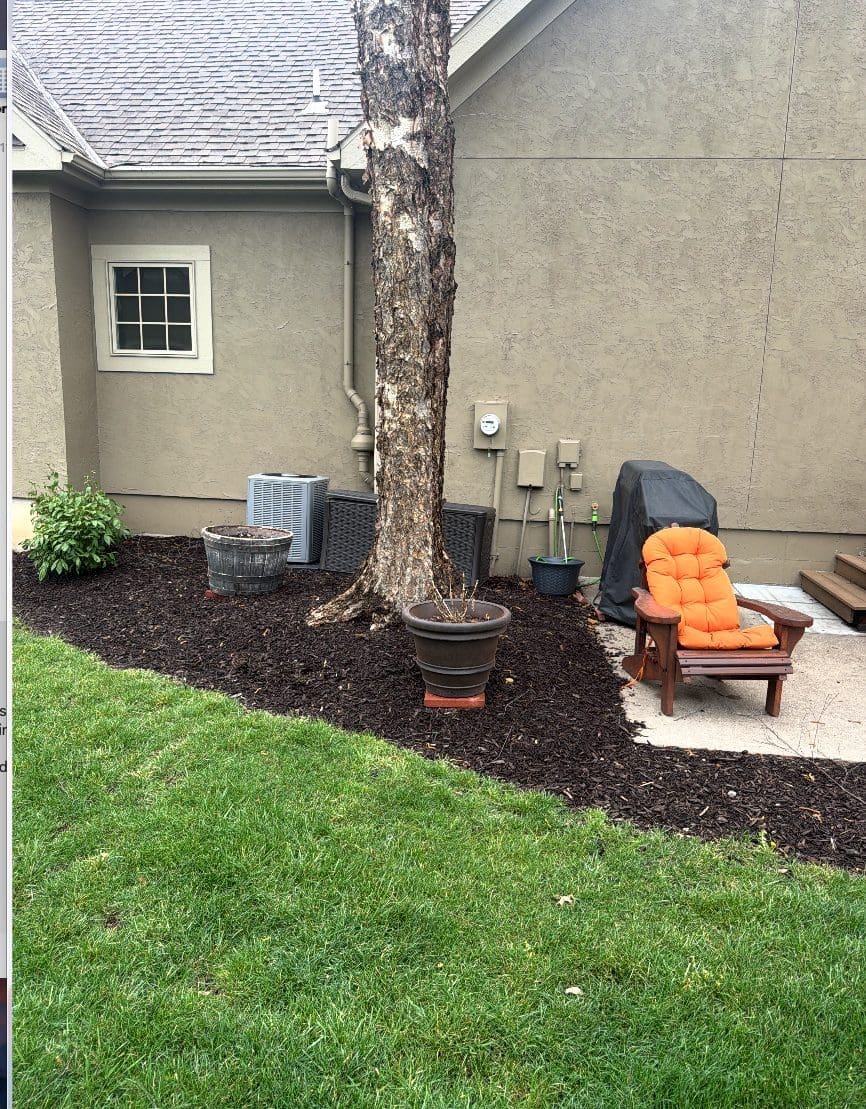
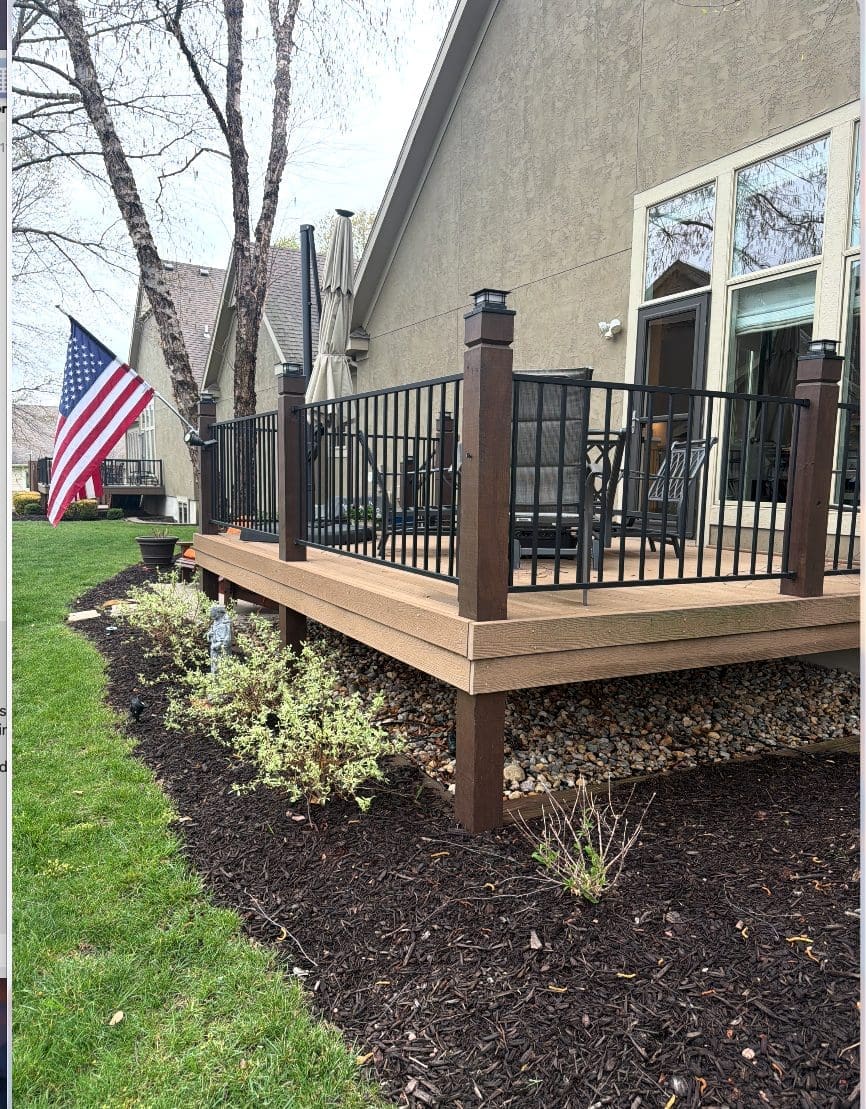
Can you build a deck around a tree?
Yes. You frame the deck around the trunk, cut the decking with an oversized opening, and the tree carries none of the deck. This is the single most common question we get from Johnson County homeowners with a mature hardwood in the way, and the answer is almost always that the tree can stay.
Three things have to be true for it to work:
- The frame goes around the tree, not against it. Joists and beams are laid out so nothing bears on the trunk and nothing is fastened to it. The tree holds up none of the deck, and the deck puts no load on the tree.
- The cutout is oversized. The opening in the decking is cut wider than the trunk on every side. That gap is what lets the tree thicken over the years. Cut it tight and the tree will win — it will push your deck boards apart.
- The root zone gets respected. Footings are placed to work around major roots instead of through them, and the grade at the base of the trunk is left alone as much as the design allows.
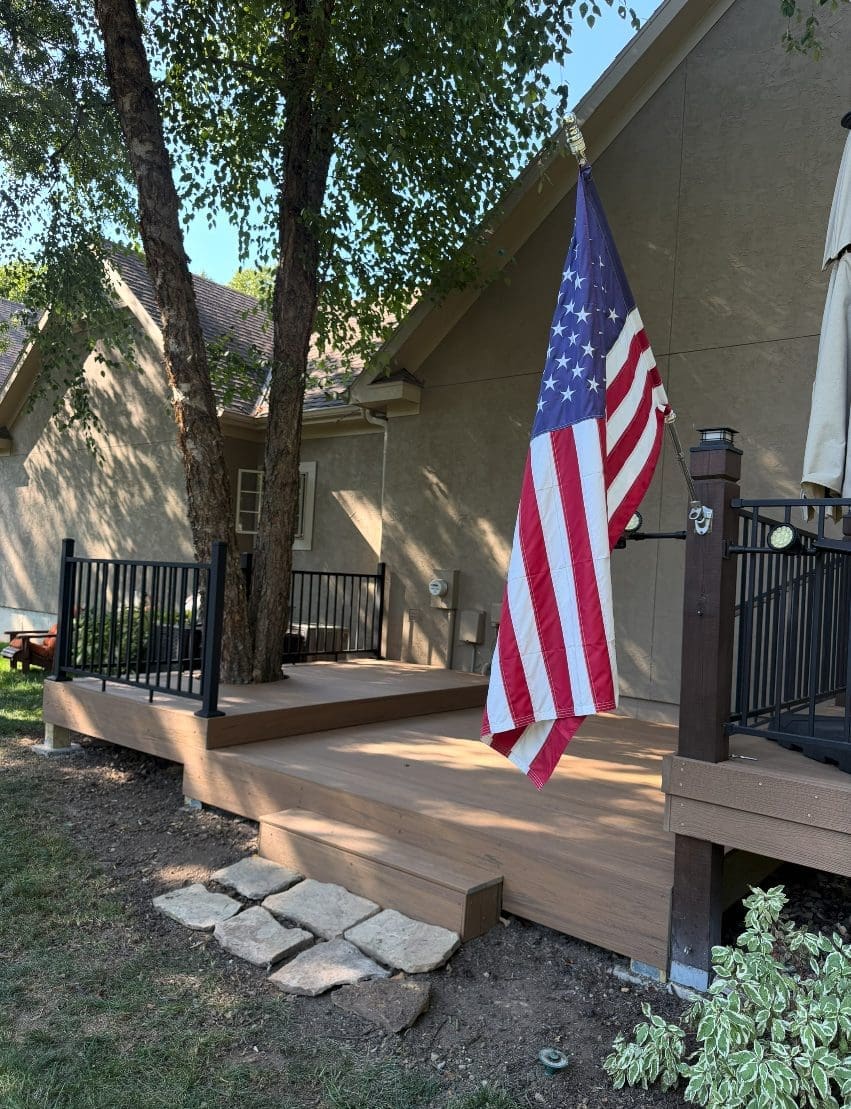
On this Shawnee project the birch was not negotiable, so the layout started with the tree and worked outward. The finished surface reads as one clean floor with the trunk coming straight up through it.

How the elevation changes were solved
Backyards in Shawnee are rarely flat, and this one falls away toward the lawn. Rather than fight the grade with a tall deck and a long run of stairs, the deck steps down with it:
- Level one sits at the same height as the bottom step of the existing upper deck, so you walk off the old deck onto the new one without changing your footing.
- Level two picks up as the deck reaches the birch, rising roughly one to two steps depending on the final grade at the trunk.
- The last step or two drops off the deck into the yard, landing on the existing flagstone path.
That stepped layout is what turns 204 square feet into two usable zones — a grilling and seating area near the house, and a shaded platform under the tree — instead of one flat rectangle you have to furnish all at once. If the grade in your own yard is the thing holding up a deck, that is a solvable problem: see our walkways, stairs and access solutions and grading and drainage work.
What is underneath: pressure-treated framing
Composite gets all the attention because it is the part you see. The frame is the part that decides whether the deck is still flat in fifteen years.
This one is framed entirely in pressure-treated lumber — beams, joists and blocking — set on footings, with the perimeter squared before a single deck board arrived. The photo below is the honest picture of a deck: consistent joist spacing, blocking where the span calls for it, and the tree already designed into the layout rather than worked around later.
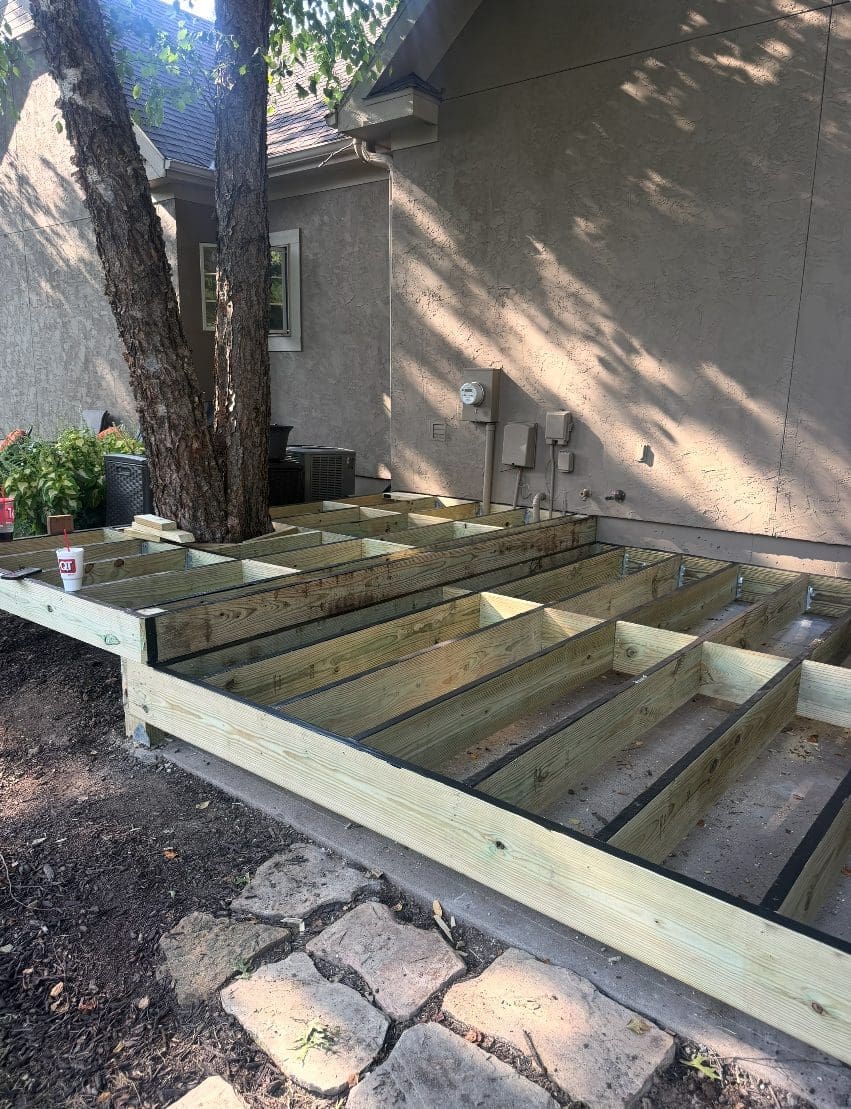
If a contractor will not show you this stage, ask why. Framing is where corners get cut, and it is the one part of a deck you cannot inspect after the boards go on.
Why composite decking for an addition in Kansas?
Kansas weather makes the argument. A Johnson County deck takes 100-degree July afternoons, ice in January, and storms that swing the humidity forty points in an hour. Wood moves under that. Composite does not move the same way — it does not splinter, it does not need a stain cycle, and it holds its color.
For an addition specifically there is a second reason: matching. When you extend an existing composite deck, composite is the only way the old and new sections read as one deck instead of a patch. We matched the homeowners existing boards so the transition off the upper deck does not announce itself.
| Composite | Pressure-treated wood | |
|---|---|---|
| Upkeep | Wash it | Clean and re-stain or seal on a cycle |
| Splinters and cracking | No | Yes, over time |
| Color | Holds | Fades, needs re-coating |
| Up-front cost | Higher | Lower |
| Matching an existing composite deck | Seamless | Will not match |
Already have a wood deck you are keeping? Then the maintenance math matters — here is our breakdown of deck staining cost in Johnson County, KS.
How long does a deck addition like this take?
A 200-square-foot composite deck addition is a matter of days on site, not weeks — layout and footings, framing, decking, then trim and cleanup. What actually moves the schedule in Johnson County is permitting, lead time on a specific composite color, and rain. Have your builder confirm permit requirements with the City of Shawnee building permits office before anything starts, and build your calendar from the permit date rather than the handshake.
The result
One continuous outdoor floor from the back door to the tree line. Two levels, a couple of steps into the lawn, and a mature birch standing exactly where it has always stood — now in the middle of the deck instead of behind it.

More work like this in our project gallery, and the full scope of what we do on deck building, repair and restoration in Johnson County, KS.
Frequently asked questions
Can a deck be built around an existing tree?
Yes. The deck frame is laid out so no joist or beam bears on the trunk and nothing is fastened to the tree, and the decking is cut with an oversized opening around the trunk so the tree has room to grow. Done that way, the tree stays healthy and the deck stays flat.
How big was this Shawnee deck addition?
12 feet wide by 17 feet long, approximately 204 square feet, built as a two-level addition off an existing upper deck.
Can you add on to an existing composite deck?
Yes. The usual approach is to start the new section at the height of the existing deck bottom step so the two flow together, and to match the new decking to the existing boards so the addition does not read as a patch.
What is a composite deck framed with?
Pressure-treated lumber for all structural framing, with composite decking on top. That is the standard combination in Kansas: composite for the walking surface, pressure-treated for the structure underneath.
Do I need a permit for a deck in Shawnee, KS?
Deck permitting is handled at the city level in Johnson County, so requirements depend on where you live. Confirm with the City of Shawnee, or have your contractor confirm, before construction starts.
Does Cascade Outdoor Services build decks outside Shawnee?
Yes. Cascade serves Shawnee and the surrounding Johnson County, Kansas area, including Overland Park, Lenexa, Olathe, Leawood and Prairie Village.
Thinking about extending your deck?
If there is a corner of your Shawnee or Johnson County backyard you walk past instead of sit in, it is usually a grade problem or a tree problem. Both are solvable, and neither one means losing the tree.