
In the heavy clay of Johnson County, a timber retaining wall is only as strong as the drainage system hidden behind it. If you’ve noticed a slight lean in your landscape or soft spots in the wood, you’re likely wondering how long do timber retaining walls last in Kansas before they require a total overhaul. It’s a frustrating sight to see a significant property investment begin to shift, especially when you aren’t sure if the failure was inevitable or simply caused by our harsh local climate.
We understand the pride you take in a well-maintained yard and the peace of mind that comes from solid craftsmanship. You should expect a professionally installed timber wall to serve your property for 15 to 25 years. In this guide, we’ll show you the specific construction techniques that prevent premature rot in JoCo soil and explain how to extend the life of your wood structures. You’ll also find a clear comparison between timber and stone, giving you the clarity needed to decide which material offers the right balance of beauty and longevity for your home.
Determining how long do timber retaining walls last in Kansas requires looking past the wood and into the soil. While many sources suggest a thirty year lifespan, the reality of our local climate and heavy clay typically results in 15 to 25 years of reliable service. The expansive nature of Johnson County soil creates immense hydrostatic pressure, which is the primary reason walls begin to lean or bow before they actually rot. This summary provides a roadmap for understanding these local challenges and the professional techniques used to overcome them.
You will discover the critical construction standards that ensure longevity, such as the installation of Deadman anchors and the necessity of a twelve inch gravel backfill for proper drainage. We also explain how to perform a simple screwdriver test to detect internal decay and when a visible “belly” in the wall signals structural failure. By focusing on these technical details and the aesthetic value of your property, you can ensure your landscape remains a polished, functional retreat. This guide helps you navigate the choice between timber and stone while highlighting the peace of mind that comes from expert craftsmanship and perennial reliability.
The Realistic Lifespan of Timber Retaining Walls in Kansas
When property owners ask how long do timber retaining walls last in Kansas, they are usually looking for a balance between immediate curb appeal and long-term value. In the Kansas City metro, a professionally built timber wall typically lasts between 15 and 25 years. While national publications often boast about 30 or 40 year lifespans, those estimates rarely account for the specific environmental stresses of the Midwest. In Johnson County, our heavy clay soil and high humidity levels act as a constant pressure cooker for wood structures.
The difference between a wall that lasts two decades and one that fails in seven years often comes down to the quality of the materials and the precision of the build. Modern 6×6 pressure-treated timbers have largely replaced the old railroad tie methods of the past. Older ties were often treated with creosote, which didn’t always penetrate the core of the wood, leading to internal rot that stayed hidden until the wall collapsed. Today, we rely on advanced treatment processes and structural standards to ensure your investment stands firm against the elements. While retaining walls can be constructed from various materials, timber remains a favorite for its rugged, natural aesthetic that feels like a seamless extension of the local landscape.
Timber vs. Stone: A Longevity Comparison
If you plan to stay in your home for the next forty years, segmental block walls are the superior choice for durability, often lasting 50 years or more. However, timber offers a warm, textured look that complements many Johnson County architectural styles perfectly. It presents a strong value-per-year proposition for homeowners who want a beautiful transformation but might move within the next decade or two. Timber provides the structural integrity you need today without the higher upfront cost of natural stone or decorative blocks.
Why Pressure-Treated Wood Matters in 2026
The chemistry of wood preservation has advanced significantly, making modern timber more resilient than ever. We only use timbers specifically rated for ground contact, which are saturated with copper-based preservatives that resist the fungi and insects common in our region. Untreated “natural” wood, even hardy species like cedar, will often fail within five years when buried in our damp soil. Proper treatment is the first line of defense against the intense freeze-thaw cycles that define our local climate. For residents dealing with moisture-heavy yards, pairing these treated materials with professional grading and drainage services is the best way to maximize the life of the wood.
Kansas Climate: The Silent Killers of Wood Walls
Kansas is notoriously tough on timber. While the quality of the wood itself is a factor, the local environment is often the real culprit when people ask how long do timber retaining walls last in Kansas. Our regional climate presents a unique set of challenges that can turn a sturdy structure into a leaning liability if it isn’t managed with expert precision. The struggle isn’t just with the wood rotting; it’s with the very ground it’s meant to hold back.
The primary antagonist is the heavy clay soil found throughout Johnson County. This soil is highly expansive, meaning it swells significantly when it absorbs moisture during our heavy spring rains and contracts during the dry summer heat. This constant “push and pull” movement fatigues the wood and the fasteners holding the wall together. Over time, the soil’s weight increases dramatically as it saturates, leading to immense pressure that wood struggles to contain without the right reinforcement. When you pair this soil movement with our high humidity levels, you create a perfect breeding ground for the fungi that cause decay.
The Impact of Hydrostatic Pressure
Hydrostatic pressure occurs when water accumulates behind the wall and has nowhere to go. During a typical Kansas downpour, thousands of pounds of water can build up in the soil. This trapped water acts like a hydraulic jack, slowly but surely pushing the timber outward. Most timber walls fail because of this pressure long before the wood actually rots. It’s the leading cause for the “belly” or bow you see in older walls. Ensuring your property has professional grading and drainage services is the only way to vent this pressure and protect the structural integrity of the wall.
Kansas Sun and “Checking”
The Midwest sun is another silent threat. In the peak of July, the intense heat dries the outer layer of the wood much faster than the interior core. This causes the wood fibers to pull apart, creating long, deep cracks known as “checking.” These cracks aren’t just aesthetic flaws; they act as funnels. They allow water and fungal spores to bypass the Wood preservative chemicals on the surface and reach the untreated wood inside. Interestingly, we often find that south-facing walls fail up to five years sooner than north-facing ones due to this sun exposure. If you’re noticing your wall starting to tilt after a heavy storm, a quick evaluation of your yard’s grading and drainage can often save the structure before the damage becomes irreversible.
Construction Standards That Double a Walls Life
While environmental factors are significant, the answer to how long do timber retaining walls last in Kansas depends largely on the technical standards used during installation. A wall built with shortcut methods might only survive eight years, whereas a structure following rigorous engineering principles can easily double or triple that lifespan. Precision in the early stages of construction ensures that the wood remains a structural asset rather than a maintenance burden, a principle shared by outdoor timber specialists like Herrings Carpentry.
One of the most critical components is the “Deadman” anchor. These are T-shaped timbers that extend six to eight feet back into the hillside, perpendicular to the wall face. They are buried deep into the stable soil behind the wall to act as a physical anchor, preventing the structure from tipping forward under the weight of saturated clay. We also prioritize the use of heavy duty six inch timber screws over traditional rebar spikes. Unlike smooth rebar, which can pull out as the wood expands and contracts, threaded screws provide a permanent, mechanical grip that keeps the courses of timber locked together for decades.
To protect the wood from the damp Kansas soil, we follow the USDA standards for treated wood to ensure every piece is rated for ground contact. However, even the best wood needs a dry environment. This is why we install a minimum of 12 inches of clean, crushed gravel backfill directly behind the wall. We wrap this gravel in a heavy duty filter fabric to prevent fine clay particles from migrating into the stone and clogging the drainage path. This layer of gravel acts as a relief valve, allowing water to drop straight down to the base of the wall rather than sitting against the timber.
The Anatomy of a High-Performance Timber Wall
Every successful wall starts below the surface. We bury the first course of timber at least six inches deep to provide a solid foundation that resists sliding. Above ground, we build the wall with a “batter,” which is a slight backward lean of about one inch for every foot of height. This tilt uses gravity to counter the natural horizontal push of the earth. At the base of the gravel backfill, a four inch perforated pipe collects the water and directs it safely away from the wall’s foundation, ensuring the ground stays stable and dry.
Why Drainage is the Best Preservative
Wood rot is a biological process that requires consistent moisture to thrive. By keeping the timber dry, you effectively halt the decay process before it begins. Integrating specialized yard drainage solutions like French drains or downspout extensions ensures that heavy runoff from your roof or upper lawn never reaches the back of the wall. When you remove the water, you remove the primary cause of failure, significantly extending how long do timber retaining walls last in Kansas yards.
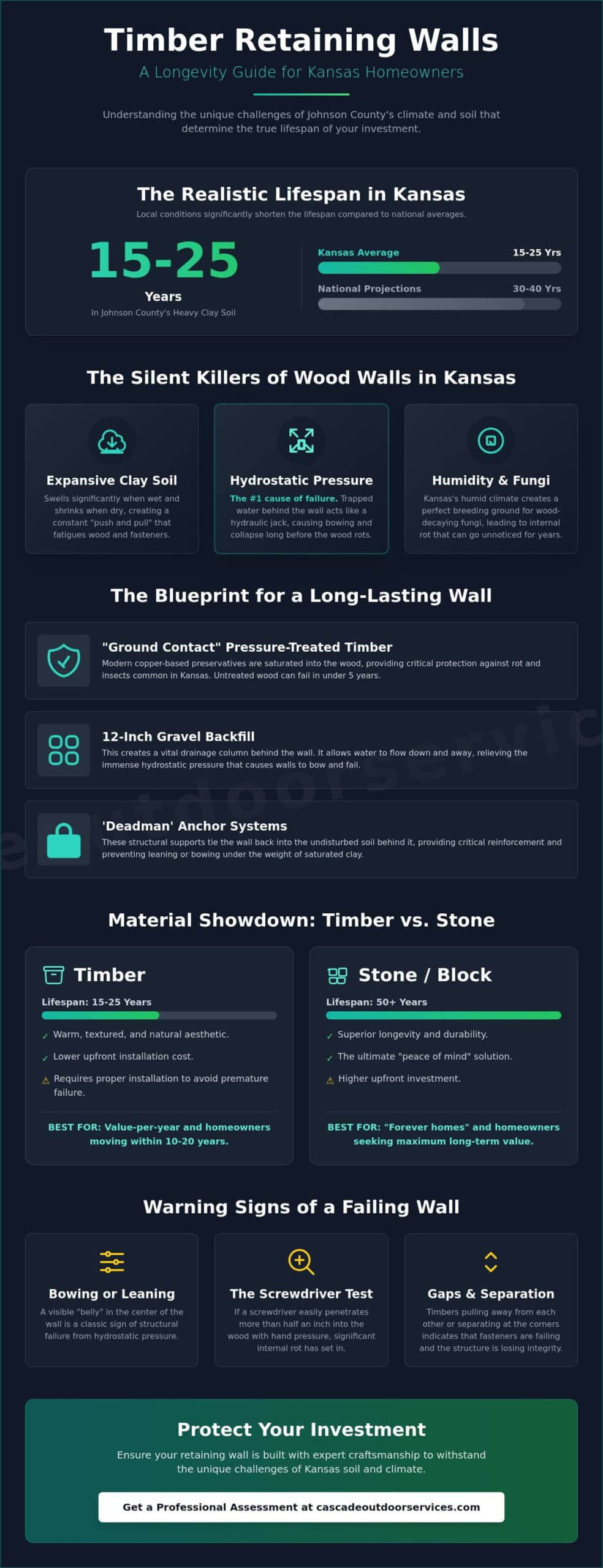
Signs Your Timber Retaining Wall is Failing
Property owners often ask how long do timber retaining walls last in Kansas because they want to know if their current structure is a ticking time bomb or just showing its age. Identifying the difference between a minor cosmetic flaw and a looming structural collapse is the key to protecting your landscape. While wood naturally weathers over time, certain visual cues tell a specific story about the health of the soil and the anchors behind the timber.
One of the most obvious signs of trouble is a “belly” or bowing in the middle of the wall. This indicates that the hydrostatic pressure we discussed earlier has finally exceeded the wall’s capacity to hold it back. If you notice a gap forming between the wall and the soil behind it, or if small sinkholes appear in the turf above the wall, your drainage system has likely failed. These sinkholes suggest that soil is being washed through the cracks, a process that hollows out the foundation of your yard. You should also check the corners; if the timbers are pulling apart, it usually means the internal deadman anchors have rotted through or were never installed correctly.
To check for internal decay that isn’t visible to the eye, you can perform a simple “screwdriver test.” Take a flathead screwdriver and try to press it into the wood in several places, especially near the ground line where moisture stays trapped. If the screwdriver sinks into the wood with little resistance, the core of the timber has rotted. When the structural heart of the wood is compromised, the wall can no longer safely support the thousands of pounds of Kansas clay pressing against it. If you are concerned about the stability of your landscape, our team can provide a professional evaluation of your grading and drainage services to determine if the wall can be saved.
Structural vs. Cosmetic Issues
It is important to distinguish between structural failure and “checking.” As mentioned previously, checking refers to the long cracks that appear as wood dries in the sun. While these cracks allow moisture in, they don’t always mean the wall is about to fall. However, a lean of more than a few inches is a structural emergency. In the hilly terrain of Johnson County, a sudden wall collapse can cause massive soil erosion and even damage your home’s foundation. While cosmetic wear can be managed—and FVCreations provides professional advice on repairing minor wood damage like splits or checks—a leaning wall usually requires a full replacement to ensure safety.
Early Intervention Strategies
If you catch a problem early, you might be able to extend the life of your structure without a total rebuild. Adding supplemental drainage, such as a French drain or a catch basin, can relieve the pressure that causes bowing. Additionally, applying a high quality sealant can slow down UV degradation and prevent the wood fibers from splitting further. For more information on how to care for outdoor wood structures, you can explore our guide on deck restoration and staining, which covers the same preservation principles needed for timber walls.
Professional Timber Wall Installation in Johnson County
Building a wall that stands the test of time in Johnson County requires more than just a stack of lumber and a few spikes. Because our local soil is dominated by heavy, expansive clay, the engineering of the wall must be the top priority. When you evaluate how long do timber retaining walls last in Kansas, you quickly realize that the difference between a 10 year failure and a 25 year success lies in the hands of the installer. We approach every project with the understanding that we aren’t just moving earth; we’re protecting your home’s foundation and enhancing your lifestyle through quality craftsmanship.
Our process begins with a comprehensive site evaluation. We don’t believe in one size fits all solutions because every yard in Overland Park, Lenexa, and Shawnee has unique drainage patterns and slope challenges. We look at where your roof water is discharging and how the natural grade of your lawn directs runoff. By identifying these factors upfront, we can design a wall that accounts for the specific hydrostatic pressures of your property. We integrate professional grading and drainage services into the very blueprint of the construction, ensuring that water is a managed guest rather than a structural threat.
Our Precision Building Process
We use only high grade 6×6 pressure treated timbers rated for ground contact. These are the heavy duty bones of your new landscape. Our team installs deep set deadman anchors every few feet, creating a mechanical bond with the hillside that resists the “push” of wet clay. Behind the timber, we create a dedicated drainage zone packed with clean gravel and wrapped in filter fabric. This level of detail is why we’re known for doing it right the first time. We take pride in the physical labor and the technical precision of the build, so you can enjoy a polished, reliable environment without the worry of future repairs.
Start Your Transformation Today
A failing or leaning wall can be a constant source of stress, but a professionally installed timber structure offers a sense of perennial reliability. Imagine the peace of mind that comes from knowing your landscape is structurally sound and aesthetically beautiful, regardless of what the Kansas weather brings. We invite you to schedule a professional evaluation to see how we can transform your outdoor space into a functional retreat. It’s time to invest in the long term health of your property. Get an expert retaining wall quote for your JoCo property and experience the difference that local expertise and disciplined craftsmanship can make.
Protect Your Property with Professional Craftsmanship
Determining how long do timber retaining walls last in Kansas is the first step toward a successful landscape metamorphosis. While our regional climate and heavy clay soil present unique challenges, they don’t have to dictate the lifespan of your property. By prioritizing advanced drainage systems and structural anchors like deadmen, you can ensure your wood structures remain a dependable asset for 15 to 25 years. The secret to longevity isn’t just the wood you choose; it’s the professional eye that understands how to manage the environment behind it.
Cascade Outdoor Services has been locally owned and operated in Johnson County since 2016. We are specialists in structural drainage and soil management, providing custom engineered solutions specifically designed for the rigors of JoCo clay. We take pride in our disciplined approach and the quiet satisfaction of quality craftsmanship. If you’ve noticed signs of failure or are planning a new project, Request a Professional Retaining Wall Evaluation today. We’re ready to help you build an outdoor retreat that stands firm against the seasons.
Frequently Asked Questions
Do timber retaining walls rot easily in Kansas?
Timber walls are vulnerable to rot in Kansas because our high humidity and heavy clay soil create a consistently damp environment. However, wood only decays when moisture is allowed to sit against the surface for long periods. By installing a robust drainage system that directs water away from the wood, you can prevent the fungal growth that leads to rot. Professional treatment and proper gravel backfilling are the best ways to keep the wood dry and structural.
How can I make my timber retaining wall last 25 years?
To reach a 25 year lifespan, you must focus on the infrastructure hidden behind the wood. Always use 6×6 pressure-treated timbers rated for ground contact and secure them with threaded timber screws rather than smooth spikes. Installing deadman anchors every few feet provides the necessary leverage to resist soil pressure. Finally, a 12 inch layer of clean gravel wrapped in filter fabric ensures that water drains away quickly, keeping the timbers stable and dry.
Is it cheaper to repair or replace a timber retaining wall?
Minor cosmetic issues or localized rot in the top courses can often be repaired by replacing individual timbers. However, if the wall is bowing or leaning, the internal anchors or drainage system have likely failed. In these scenarios, replacement is usually more cost-effective than a temporary fix. A full replacement allows you to address the root cause of the structural failure, ensuring your property remains polished and safe for decades to come.
Does Kansas clay soil affect wood walls more than stone?
Kansas clay is highly expansive, meaning it swells significantly when wet and puts immense pressure on any landscape structure. While stone and segmental blocks are heavier and naturally more resistant to this force, timber is lighter and can shift if the installation isn’t precise. This is why the question of how long do timber retaining walls last in Kansas is so dependent on the use of deep-set anchors and professional soil management techniques that account for clay expansion.
Should I use railroad ties or 6×6 timbers for my wall?
Modern 6×6 pressure-treated timbers are the superior choice for residential landscapes. They provide a uniform shape for better stacking and consistent chemical penetration for rot resistance. Older railroad ties are often recycled and may already have internal decay or leaching creosote that can harm your soil. For a premium, clean aesthetic that enhances your property value, 6×6 timbers offer a more predictable longevity and a more refined look for your outdoor space.
Can I build a timber wall myself to save money?
While homeowners can handle small decorative borders, structural retaining walls require a deep understanding of soil mechanics. In Johnson County, the hydrostatic pressure from a saturated hillside can be immense. Mistakes in drainage or anchoring often lead to a total collapse within a few years, which can damage your foundation or surrounding landscape. Hiring a professional ensures the project is done correctly the first time, giving you the peace of mind that comes with expert craftsmanship.
How much drainage gravel is needed behind a timber wall?
We recommend a minimum of 12 inches of clean, crushed gravel directly behind the timber courses. This gravel column should extend from the base of the wall to within six inches of the surface. This creates a clear path for water to reach the perforated drain pipe at the bottom. Without this specific volume of gravel, water will saturate the soil and push against the wall, which is the leading cause of premature leaning and failure in our region.
What is the best wood for a retaining wall in the Midwest?
Pressure-treated Southern Yellow Pine is the most reliable choice for the Midwest climate. It is specifically engineered to absorb preservative chemicals deep into the wood fibers, making it highly resistant to local fungi and insects. While cedar is naturally rot-resistant, it often lacks the structural density required for larger, load-bearing walls. To maximize how long do timber retaining walls last in Kansas, always ensure your lumber is explicitly rated for ground contact and professional-grade use.
Planning a retaining wall in Johnson County?
Cascade Outdoor Services builds and rebuilds retaining walls across Johnson County, Kansas — Overland Park, Olathe, Shawnee, Lenexa, Leawood and Prairie Village. We engineer for JoCo clay, drain the wall properly from the start, and put the scope in writing before work begins.
Takes about two minutes. Prefer to talk it through? Call (913) 299-5613 — we answer the phone.