
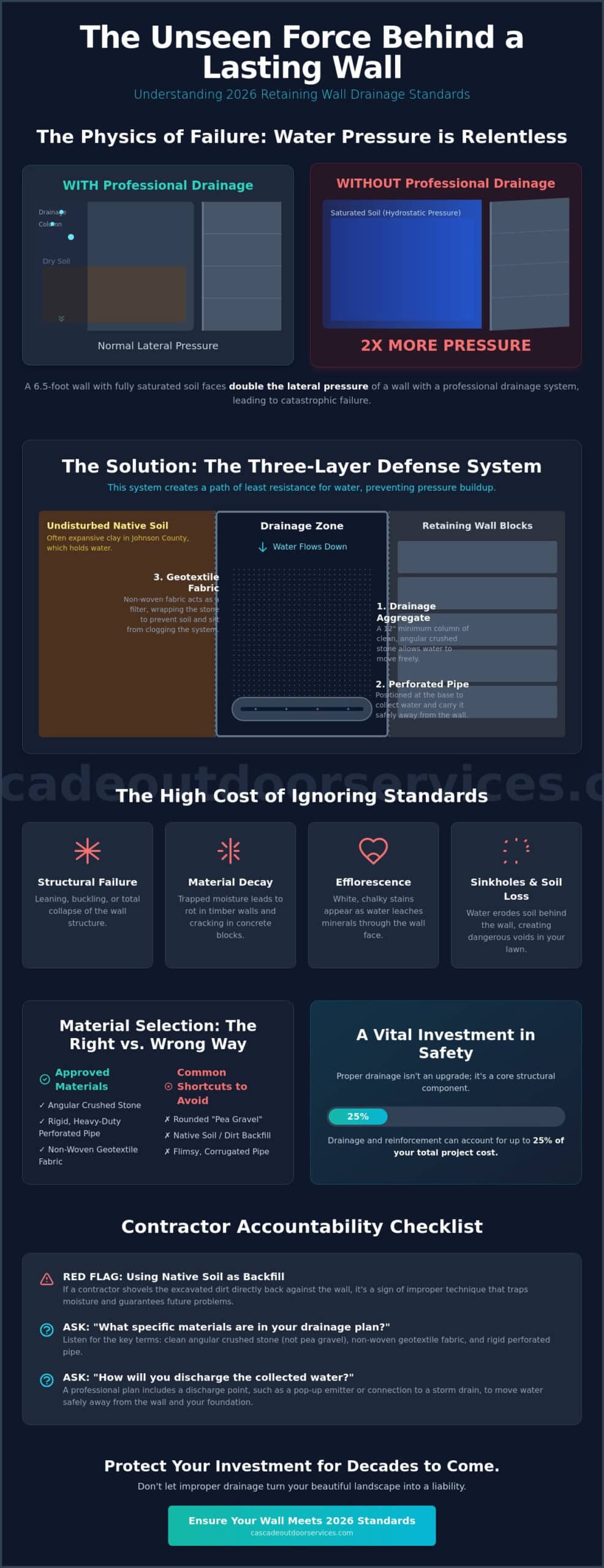
A 6.5-foot retaining wall with fully saturated soil behind it faces double the lateral pressure of a wall with a professional drainage system. It’s a staggering reality that explains why so many structures in our region begin to lean or buckle after just a few heavy seasons. You’ve likely felt that knot in your stomach watching heavy rain turn your backyard into a swamp, wondering if your investment will hold up against the weight. Mastering the 2026 retaining wall drainage design standards is the only way to move past technical jargon and ensure your property remains secure.
We’re going to provide you with a clear checklist to hold contractors accountable and explain why our local clay soil requires specialized drainage solutions. You’ll see why drainage and reinforcement can account for up to 25 percent of your total project cost and why that’s a vital investment in your home’s safety. This guide offers the technical clarity you need for total peace of mind, transforming your yard from a source of stress into a permanent, polished extension of your home.
Key Takeaways
- Understand the “Three-Layer Defense” system that uses specific aggregate columns and perforated pipes to divert water before it damages your wall.
- Learn why current retaining wall drainage design standards favor rigid pipe and non-woven geotextile fabrics to prevent clogs and structural shifting.
- Discover how to adapt your landscape for Johnson County’s expansive clay soil and harsh freeze-thaw cycles that threaten wall stability.
- Identify red flags in contractor proposals and master the critical questions to ask to ensure your drainage plan meets 2026 technical requirements.
- Gain the confidence to oversee your hardscaping project, ensuring your landscape investment remains a beautiful, functional extension of your home for decades.
The Physics of Failure: Why Drainage Standards Exist
A retaining wall is a structural investment, yet many homeowners view it as a simple partition. In reality, your wall is a dam. It’s constantly resisting the massive weight of the earth behind it. When rain falls, that earth changes. Saturated soil doesn’t just get heavier; it begins to act like a liquid, exerting lateral force known as hydrostatic pressure. This is the primary reason grading and drainage services in Johnson County are so critical for long-term property value.
Adhering to strict retaining wall drainage design standards is the only way to ensure your structure doesn’t become a liability. While dry soil typically weighs about 100 to 120 pounds per cubic foot, adding water to the mix creates a compounding load. A 2-meter wall with fully saturated soil experiences roughly double the lateral pressure compared to a wall with proper drainage. This is why “Global Stability” is a key standard in professional design. It ensures the entire mass of the wall and the soil behind it remains a single, unmoving unit rather than a sliding hazard.
Understanding Hydrostatic Pressure
Water molecules are relentless. As they accumulate behind a wall, they seek any path of escape. If they can’t drain away, they push against the back of your timber or segmental blocks with incredible force. This creates the “leaning wall” syndrome many neighbors recognize. It’s not usually the soil failing; it’s the trapped water exerting more force than the wall was built to handle. Weep holes, often spaced 6 to 10 feet apart, are a start, but they are merely the exit points. A true system requires an internal network to guide water to those exits before pressure builds.
The Consequences of Sub-Standard Drainage
The fallout of ignoring what can happen without proper drainage is often expensive. Beyond a total collapse, you’ll see early warning signs. In block walls, this often looks like efflorescence, those white, chalky salt stains that appear as water leeches through the concrete. For timber walls, trapped moisture leads to rapid rot and structural softening. Perhaps most frustrating is soil migration. When water finally finds a gap, it often carries your expensive topsoil and mulch with it, leaving hollow pockets behind the wall that eventually lead to sinkholes in your lawn. Ignoring retaining wall drainage design standards turns a beautiful landscape into a series of structural emergencies.
Industry Standards for Retaining Wall Drainage Systems
A wall that looks beautiful on the surface is only half the project. The unseen components behind the face of the wall determine whether that structure stands for five years or fifty. Professional builders rely on a “Three-Layer Defense” to manage water flow. This system is the backbone of modern retaining wall drainage design standards, ensuring that hydrostatic pressure never has the chance to build up. By using a combination of specialized aggregate, filtration fabric, and perforated piping, we create a path of least resistance for groundwater.
Adhering to these technical requirements is especially important in our region, where soil types can vary significantly from one property to the next. For deep technical specifications on how these systems are engineered at a municipal level, the MoDOT Engineering Policy Guide offers a comprehensive look at subsurface drainage requirements. While homeowners don’t need to be engineers, understanding these three standards allows you to verify that your contractor isn’t cutting corners on the parts of the wall you’ll never see again.
The Drainage Aggregate Column
Standard practice requires a minimum 12-inch column of clean, angular crushed stone placed directly behind the wall units. We avoid rounded “pea gravel” because angular stone locks together, providing better structural support while maintaining the large voids needed for rapid water movement. One of the most common violations of retaining wall drainage design standards is using native soil or “dirt backfill” against the wall face. Soil holds moisture like a sponge, while clean stone allows it to drop straight down to the collection pipe. If you see a contractor shoveling the dirt they just dug out back against the wall, it’s a major red flag for future failure.
Perforated Pipe (French Drain) Integration
The perforated pipe is the highway that carries water away from the structure. It must be placed at the lowest possible point, typically behind the first course of block or timber, with the perforations facing downward. This allows the water table to rise into the pipe from below before it can reach the wall’s base. To ensure the system actually works, the pipe must be pitched or sloped toward an exit point. We call this “daylighting” the pipe, which means extending it to a lower spot in the yard or through the wall face via a specialized outlet. If you are concerned about how water moves across your property, our team can help with professional grading and drainage services in Johnson County to ensure every drop has a safe place to go.
Geotextile Separation
The final layer of defense is non-woven geotextile fabric. This fabric acts as a filter between the drainage stone and the native soil. Without this barrier, fine silt and clay particles will eventually migrate into the stone column, filling the voids and clogging the perforated pipe. A clogged system is just as dangerous as no system at all. By wrapping the aggregate column in high-quality fabric, we ensure the drainage system remains “clean” and functional for the entire lifespan of the wall.
Material Selection: Standards for Longevity
Picking the right materials is where the theory of retaining wall drainage design standards meets the reality of your backyard. Even a perfectly sloped trench will fail if the pipe inside it collapses under the weight of the stone. Professional installers look to the CMHA Design Manual for guidance on how specific materials interact with segmental units. Choosing the wrong components often leads to what we call “silent failure,” where the system looks fine from the outside while it’s actually clogging or crushing underground.
The Pipe Debate: Rigid vs. Flexible
Most big-box stores push flexible, corrugated black pipe because it’s cheap and easy to transport. However, in a structural retaining wall, this is often a mistake. Corrugated pipe is prone to “pancaking” under the weight of the aggregate column. We prefer rigid SDR-35 PVC pipe for its superior strength and smooth interior walls that prevent debris buildup. Structural wall pipes must maintain a crush rating sufficient to withstand the vertical load of the aggregate and soil above them without deforming or restricting flow. If your pipe fails, your entire drainage system is effectively paralyzed, leaving your wall vulnerable to the hydrostatic pressure we discussed earlier.
Geotextiles: The Filter Standard
The fabric you choose is just as critical as the pipe. You’ll find two main types: woven and non-woven. Woven fabrics are great for stabilizing a driveway, but they have poor water permeability. For drainage, non-woven geotextile fabric is the industry standard. It allows water to pass through while trapping the tiny silt and clay particles that would otherwise clog your stone. We use the “burrito wrap” method, encasing the entire aggregate column in fabric to create a permanent filter. Skipping this step is one of the most common 5 French drain mistakes to avoid when protecting your landscape.
Backfill and Timber Treatment
Native soil, especially the heavy clay common in our area, is rarely suitable for backfill because it doesn’t drain. Clean, 1-inch crushed limestone is the standard for a reason. It provides the structural stability needed while allowing water to drop straight to your collection pipe. If you’re building a timber wall, ensure the wood meets UC4B “Ground Contact” standards. This level of treatment is designed for structural support and heavy moisture exposure, preventing the rot that plagues lower-grade lumber. Investing in these premium materials ensures your wall remains a beautiful, functional part of your property for decades rather than a project you have to redo in five years.
Local Standards: Adapting for Johnson County Clay
Generic construction guides often assume you are working with well-draining, sandy soil. In our corner of Kansas, that is rarely the case. The heavy clay soils common in Overland Park and Olathe act like a dense sponge, trapping moisture and swelling significantly as they saturate. This expansion creates a unique set of challenges that standard retaining wall drainage design standards must address to prevent structural failure. When we build in Johnson County, we aren’t just fighting gravity; we’re fighting the physical expansion of the earth itself.
Managing Clay Soil Expansion
Clay is different from other soil types because it holds water at a molecular level. While sand allows water to pass through, clay expands outward as it absorbs moisture, exerting massive lateral pressure against your wall. To combat this, we often specify deeper aggregate pockets than what might be required in other regions. This extra stone serves as a buffer, giving the clay room to expand without pushing directly against the timber or block. Proper surface grading is also vital. By ensuring the area at the top of the wall crest is sloped away from the structure, we prevent the clay from becoming oversaturated in the first place.
Our regional climate adds another layer of stress through intense freeze-thaw cycles. When trapped water in the clay freezes, it expands even further, a process known as frost heave. Without a robust drainage system to remove that water before the first hard freeze, your wall faces a “jackhammer” effect every winter. This is why we prioritize high-capacity systems that can handle the sudden, heavy rain events typical of Kansas City spring storms. If you want to ensure your property is protected against these local conditions, it’s worth consulting an expert in grading and drainage services in Johnson County.
Regulatory Standards in JoCo
Navigating municipal codes is just as important as managing the soil. In most of Johnson County, including Shawnee and Lenexa, a permit is required for any retaining wall over 4 feet in height, measured from the bottom of the footing to the top of the wall. In Overland Park, reaching that 48-inch threshold also triggers the requirement for a sealed engineered design. These regulations exist because the risk of a collapse increases exponentially with height, especially with our local soil loads. For homeowners and developers looking for high-precision modeling to support these complex builds, CRAYDL provides specialized BIM and VDC modeling that ensures every technical detail is accounted for during the planning process. Beyond permits, property line etiquette is a major factor. You must ensure that your wall’s drainage system doesn’t dump concentrated water onto a neighbor’s property, which could lead to legal disputes or drainage violations. Following these retaining wall drainage design standards ensures your project is both structurally sound and compliant with local community expectations.
Contractor Accountability: Evaluating the Design
One of the most common pitfalls is the “lowest bid” trap. In the world of hardscaping, a lower price often means the contractor is skipping the invisible components. Since drainage and reinforcement can account for up to 25 percent of a project’s total cost, it’s the first place an unethical builder will look to save money. They might skip the geotextile fabric or use native clay for backfill instead of clean stone. These omissions aren’t immediately visible, but the hydrostatic pressure will eventually reveal the truth. Holding your contractor accountable requires asking specific, pointed questions before the first shovel hits the ground.
- What specific pipe material are you using? If they say “the black corrugated stuff,” ask for rigid SDR-35 instead.
- How many inches of clean aggregate will be placed behind the wall? Standards require at least 12 inches of clean, angular stone.
- Where exactly does the water exit the system? Every pipe needs a clear “daylight” point or a connection to a catch basin.
- Are you using a non-woven geotextile to wrap the stone column? Without this, your drainage system will eventually clog with silt.
The Pre-Construction Checklist
Before the project begins, review your written contract for specific material callouts. A professional quote shouldn’t just say “gravel,” it should specify “1-inch clean crushed limestone.” During the excavation phase, step outside and look at the trench. You should see a clear separation between the native soil and the area where the wall will sit. If you see the crew shoveling the dirt they just removed back against the wall blocks, stop the project immediately. That soil will trap moisture and eventually lead to the structural failure we’ve worked so hard to avoid.
The Cascade Standard: Precision and Performance
At Cascade Outdoor Services, we view retaining wall drainage design standards as the bare minimum. We build every timber and segmental block project to exceed national requirements, specifically tailoring our methods to the unique demands of Johnson County’s expansive clay. We take pride in the physical labor of deep excavation and precise aggregate placement so you don’t have to worry about the next heavy rain. Our goal is a total metamorphosis of your outdoor space, turning a failing slope into a polished, permanent asset for your home. If you’re ready for a structure built with perennial reliability in mind, Schedule a structural evaluation of your retaining wall today and experience the peace of mind that comes from true craftsmanship.
Secure Your Landscape Investment for the Decades Ahead
A retaining wall is much more than a stack of stones; it’s a vital structural system designed to withstand the unique pressures of the Kansas landscape. By prioritizing professional retaining wall drainage design standards, you move from a place of uncertainty to long-term confidence in your property’s stability. Remember that the “Three-Layer Defense” of aggregate, fabric, and rigid pipe is your best protection against the expansive clay and harsh winters of Johnson County. These unseen components ensure your wall remains a permanent asset rather than a future liability.
Cascade Outdoor Services has been providing locally owned JoCo expertise since 2016. We specialize in structural timber and block solutions with a comprehensive focus on grading and water management. Our team understands that the quiet satisfaction of a well-maintained environment starts with the technical work happening beneath the surface. We take pride in the rugged labor so you can enjoy the refined beauty of your outdoor retreat without the fear of structural failure.
Request a Professional Drainage & Retaining Wall Quote
Take the first step toward a permanent metamorphosis of your yard today. We look forward to being your reliable partner in enhancing your community’s shared spaces and ensuring your landscape investment lasts for decades.
Frequently Asked Questions
Do all retaining walls need a drainage system?
Yes, every structural retaining wall requires a dedicated drainage system to manage water pressure effectively. While a tiny garden border might survive without one, any wall holding back significant earth must vent moisture to prevent failure. Modern retaining wall drainage design standards prioritize water management because trapped liquid is the primary cause of wall collapse. Even during dry spells, soil retains moisture that can exert massive lateral force against your blocks or timbers.
How far apart should weep holes be spaced according to standards?
Weep holes should typically be spaced between 6 and 10 feet apart along the base of the wall. This spacing ensures that water collecting in the aggregate column has frequent exit points before pressure builds up behind the face. In our local clay heavy environment, keeping these openings clear of debris is essential for performance. For taller walls or areas with high water tables, an engineer might specify even tighter spacing to handle the increased flow.
What is the best gravel for retaining wall drainage?
Clean, angular crushed stone is the industry gold standard for backfill material. We recommend 1 inch limestone because the sharp edges lock together for structural stability while leaving large voids for water to pass through. Avoid using rounded pea gravel or river rock for this purpose. Those materials can shift under pressure and don’t provide the interlocking support required for long term wall integrity and consistent water movement.
Can I use a French drain instead of weep holes?
A French drain and weep holes work best as a combined system rather than alternatives. The perforated pipe of a French drain collects water from the entire length of the wall and directs it to a specific discharge point. Weep holes provide a secondary pressure relief valve directly through the wall face. Using both ensures that even if one part of the system is overwhelmed during a heavy Kansas storm, the other continues to protect the structure.
What happens if my retaining wall drainage pipe gets clogged?
A clogged drainage pipe causes hydrostatic pressure to build rapidly, which often leads to bowing, cracking, or total wall failure. You might notice early warning signs like efflorescence, which are white, salty stains on the wall face where water is forcing its way through the blocks. Because clay soil in Johnson County is prone to silting, we always use non-woven geotextile fabric to wrap the system and prevent these dangerous clogs from forming.
Does Johnson County require a permit for retaining wall drainage?
Johnson County requires a permit for any retaining wall over 4 feet in height, measured from the bottom of the footing to the top. When you apply for this permit in cities like Overland Park or Shawnee, your drainage plan is a critical part of the reviewed engineering. Even for shorter walls that don’t trigger a permit, following professional retaining wall drainage design standards is essential to ensure the structure doesn’t negatively impact your neighbor’s property.
How do I know if my existing wall has poor drainage?
Visible leaning, water pooling at the base, and soil washing out from between joints are clear indicators of poor drainage. You should also look for frost heave, where the wall appears to have shifted or lifted after a cold winter. If the wall face stays damp long after a rainstorm ends, the internal aggregate is likely clogged or nonexistent. These issues suggest the water has nowhere to go but against the structure itself, creating a structural risk.
Is perforated pipe better than solid pipe for retaining walls?
Perforated pipe is necessary for the collection phase behind the wall, while solid pipe is better for transporting that water to a final discharge point. The holes in a perforated pipe allow groundwater to enter the system from the surrounding stone. Once the water is in the pipe and moving away from the wall, switching to a solid pipe prevents that water from leaking back into the soil near your foundation or other sensitive landscape areas.
Planning a retaining wall in Johnson County?
Cascade Outdoor Services builds and rebuilds retaining walls across Johnson County, Kansas — Overland Park, Olathe, Shawnee, Lenexa, Leawood and Prairie Village. We engineer for JoCo clay, drain the wall properly from the start, and put the scope in writing before work begins.
Takes about two minutes. Prefer to talk it through? Call (913) 299-5613 — we answer the phone.