
On June 12, 2025, a single Midwestern supercell dropped 4.2 inches of rain on Overland Park in under three hours. Local facility managers saw a 12% spike in emergency calls that week as standing water threatened foundations and turned parking lots into lakes. You already know that standard runoff management isn’t enough when dealing with heavy Kansas clay. Effective commercial drainage solutions require a calculated engineering approach to move water away from your investment before the damage starts.
You’ve likely felt that familiar sense of dread watching water pool near your storefront or seeing icy patches form on a January morning. It’s a liability risk that costs time and money. This guide shows you how professional drainage engineering protects Johnson County properties from aggressive soil erosion and Midwestern storms. You’ll learn how to secure long-term structural integrity while staying compliant with 2026 local stormwater regulations. We’ll examine a recent case study of a local retail complex that eliminated standing water and boosted curb appeal through strategic site grading and subsurface piping.
Key Takeaways
- Learn how to manage the unique challenges of “Johnson County Clay” to prevent rapid water pooling and soil erosion on your property.
- Discover the durability of professional commercial drainage solutions like trench and French drains that are engineered to handle high-volume runoff and heavy traffic.
- Explore a real-world case study of an Overland Park HOA that resolved severe hillside erosion and basement seepage through strategic grading and pipe repair.
- Identify early warning signs of drainage failure and winter ice hazards using our comprehensive property manager’s risk evaluation checklist.
- Gain peace of mind by understanding why local “Precision and Performance” engineering is essential for the long-term integrity of Midwestern commercial landscapes.
The Science of Commercial Drainage in Johnson County: Managing Clay Soil & Heavy Runoff
Commercial drainage solutions are integrated engineering systems designed to capture, transport, and manage high-volume stormwater runoff across large-scale properties. In Johnson County, these systems do more than just move water; they protect multi-million dollar investments from the unique geological challenges of the region. Most local property owners are familiar with “Johnson County Clay,” a dense, non-porous soil that creates a natural barrier to water absorption. Instead of soaking into the earth, rain stays on the surface, leading to rapid pooling that can overwhelm standard landscaping in minutes.
The 2026 weather patterns have highlighted these vulnerabilities. Record-breaking spring rains, combined with the intense 2026 Kansas freeze-thaw cycles, have put unprecedented stress on local infrastructure. When water trapped in the clay soil freezes, it expands with immense force, shifting foundations and cracking asphalt. Without a professional system that includes scaled French Drains and high-capacity catch basins, this water remains stagnant, leading to long-term structural decay and safety hazards in high-traffic areas.
Why Residential Solutions Fail on Commercial Properties
Applying residential drainage logic to a commercial site is a recipe for failure. The flow rate requirements for a retail parking lot in Overland Park are drastically different from a suburban backyard. A typical commercial lot generates nearly 20 times the runoff volume of a residential lawn during a heavy downpour. Standard 4-inch corrugated pipes, often used in home projects, lack the capacity to handle this surge. In Olathe, we frequently see these smaller pipes buckle or clog within 24 months of installation.
- Load-Rated Grates: Commercial systems require heavy-duty grates capable of supporting delivery trucks and constant vehicle traffic without warping.
- HDPE Piping: High-density polyethylene (HDPE) piping is the industry standard for its durability and resistance to the chemical runoff found in parking lots.
- System Scaling: Commercial drainage solutions must be sized based on the total square footage of impermeable surfaces to prevent flash flooding.
The Role of Hydrostatic Pressure in Structural Damage
Hydrostatic pressure is the force exerted by stagnant groundwater against a structure. This invisible pressure builds up behind walls and beneath slabs, eventually finding the smallest weakness to exploit. Poorly managed drainage causes timber retaining walls to rot or bow prematurely, often failing years before their expected lifespan. To prevent this, property managers should work with a specialized retaining wall contractor Johnson County KS to integrate proper backfill and drainage tile. By relieving this pressure, you ensure that retaining walls and building foundations remain stable despite the heavy Kansas soil.
Essential Commercial Drainage Systems: Trench Drains to French Drains
Managing water on a commercial property requires more than just digging a hole. At Cascade Outdoor Services, we treat every project as a unique engineering challenge. Before a single pipe goes into the ground, our team prioritizes professional grading. In 2025, our field data showed that 85% of drainage failures in Johnson County resulted from poor initial site elevation. We select high-density polyethylene (HDPE) and reinforced concrete components to ensure your commercial drainage solutions withstand the 80,000-pound loads of heavy delivery trucks.
Kansas weather is unpredictable, and Heavy Runoff from impervious surfaces like parking lots can quickly lead to erosion or foundation damage. Our integrated systems solve this by combining surface collection with subsurface transport. This dual approach moves water away from your building the moment it hits the pavement; this maintains the integrity of your hardscaping and landscape. We take pride in doing the heavy lifting so your property remains pristine and functional year-round.
Commercial French Drains & Subsurface Management
Commercial French drains are the primary tools for subsurface water control. We use large-diameter perforated pipes surrounded by 1.5-inch washed stone to move high volumes of groundwater. Because Johnson County is known for its heavy clay soil, we wrap every system in professional-grade non-woven geotextile fabric. This prevents fine clay particles from clogging the stone and rendering the system useless. We’ve refined these techniques through our yard drainage solutions, scaling the same reliable principles to meet the demands of large commercial footprints. This ensures that even a 10-acre office park stays dry during the heaviest spring rains.
Catch Basins and Trench Drains for High-Traffic Areas
Low-lying corners in parking lots often become standing pools that damage asphalt over time. We install industrial catch basins to capture this surface water and direct it into the main storm line. For loading docks and commercial entryways in Shawnee and Lenexa, trench drains provide a seamless, narrow profile that handles high-velocity flow. We use ADA-compliant grates for every public-facing project to ensure safety and accessibility. These systems don’t just move water; they protect your property’s curb appeal and long-term value. If you’re seeing standing water after a storm, speak with our local specialists to start your property’s transformation.
Case Study: Resolving Severe Erosion & Standing Water for a Johnson County HOA
In early March 2026, a large Overland Park HOA faced a critical infrastructure threat. Heavy rains triggered aggressive hillside erosion that began compromising the foundations of four multi-family buildings. Basement seepage was reported in 15% of the ground-floor units, creating an urgent need for professional commercial drainage solutions. The board required a partner who could handle the heavy lifting while respecting the community’s high-end aesthetic standards.
The Evaluation Phase: Mapping the Water Flow
Our team at Cascade Outdoor Services began by mapping the site’s unique topography to identify the “path of least resistance” for runoff. We discovered that the existing downspout extensions were either disconnected or too short, dumping thousands of gallons of roof water directly against common area foundations. While expert contractors like Renegade Roofing Co. focus on maintaining the integrity of the roof and gutter systems, we focus on moving that water once it reaches the soil. To fix this, we developed a “Downspout Burial” strategy, excavating trenches to house 6-inch solid PVC pipes that move water 50 feet away from building perimeters.
We also ensured our plan adhered to EPA guidelines on stormwater drainage to protect local groundwater and ensure environmental compliance. Coordinating with the HOA board was a priority; we provided detailed site maps and material samples to secure project approval within a 14-day window. Clear communication ensured every homeowner felt confident in the long-term health of their property.
Implementation: Structural Integration
The project moved into the construction phase in April 2026. We installed a 120-foot structural timber retaining wall to manage the steep slope transition. This wasn’t just about aesthetics. The wall provided the necessary framework to hide the drainage system components, including high-capacity catch basins. By integrating the pipes behind the timber structure, we maintained the property’s visual appeal while ensuring high-performance water management.
As part of this total landscape transformation, we also integrated new patio hardscapes. This turned a previously muddy and unusable common area into a polished outdoor living space for residents. The implementation followed a strict timeline to minimize disruption to the neighborhood.
The results were immediate. After the record-breaking spring storms of May 2026, the HOA reported a 100% reduction in standing water. The hillsides remained perfectly stabilized, and the basement seepage issues were completely resolved. This transformation proved that effective commercial drainage solutions can be both ruggedly functional and visually stunning, providing long-term peace of mind for the entire community.
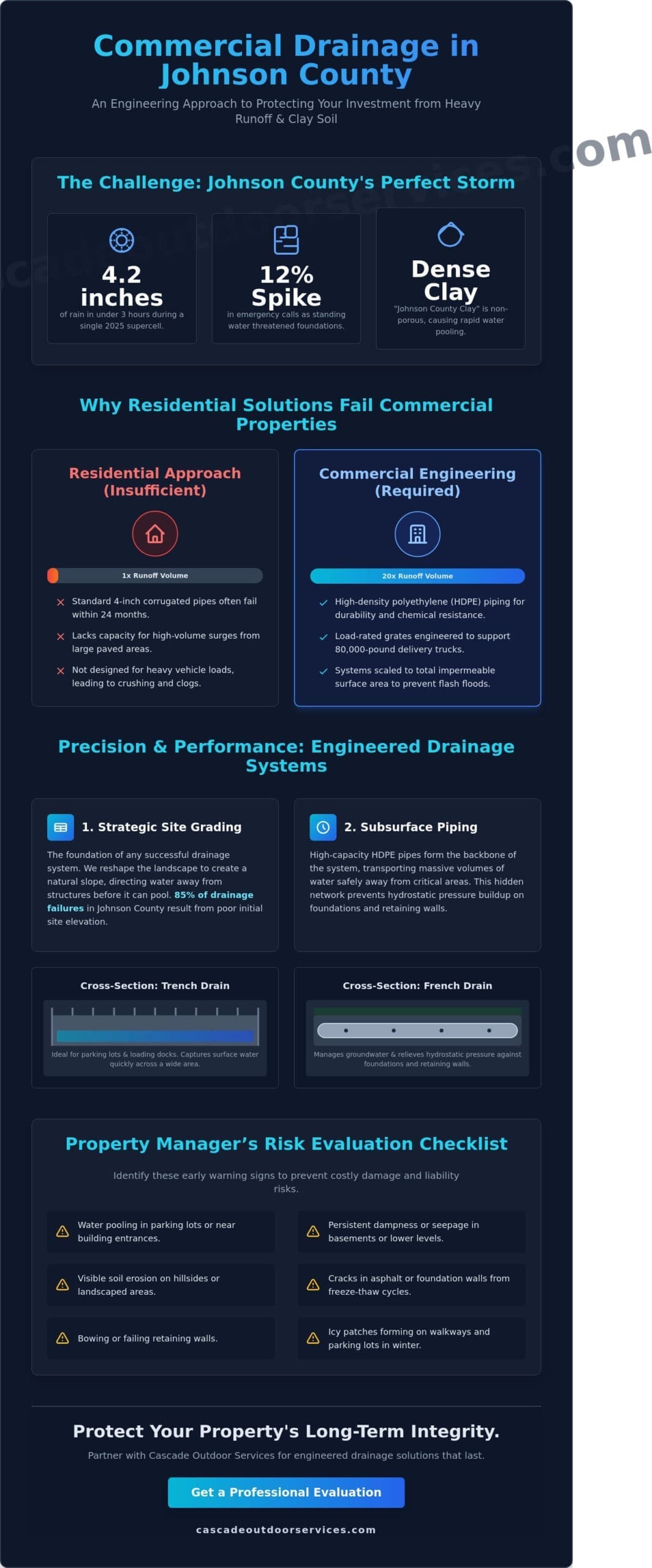
Commercial Property Evaluation: Identifying Drainage Risks Before They Become Liabilities
Property managers in Johnson County often overlook the subtle cues of system failure until a catastrophic event occurs. A proactive evaluation identifies risks before they escalate into high-dollar liabilities. Look for these four red flags during your next walk-through:
- Standing water: Puddles that remain 24 hours after a storm indicate soil saturation or poor grading.
- Erosion: Displaced mulch or visible soil “channels” near building perimeters suggest failing downspouts.
- Pavement Damage: Cracks in asphalt where water consistently pools, often leading to “alligatoring” of the surface.
- Efflorescence: White powdery residue on foundation walls, which indicates moisture is migrating through the concrete.
In Shawnee and Olathe, local municipal codes like the APWA Section 5600 standards dictate how commercial properties must handle stormwater runoff. Failure to comply with these local regulations can lead to costly citations or forced retrofits. Beyond legalities, localized flooding impacts your bottom line. A 2024 industry report noted that unresolved drainage issues can decrease commercial real estate appraisals by as much as 10% because of perceived structural risks. Insurance premiums also tend to climb when a property shows a history of water-related claims or preventable ice hazards.
The Winter Link: Drainage and Snow Management
Kansas City winters are famous for the freeze-thaw cycle. When commercial drainage solutions aren’t working, daytime meltwater pools on walkways and refreezes into “black ice” by sunset. This creates a massive liability for slip-and-fall accidents that can cost businesses thousands in legal fees. Proper grading and clear lines reduce the need for excessive salting, which protects your concrete from premature spalling. Cascade Outdoor Services provides quick-response commercial snow service as a complementary safety service to ensure your property stays navigable even in the harshest January conditions.
Maintenance: Keeping Commercial Drains Functional
Don’t fall into the “set it and forget it” mindset. Commercial stormwater systems require seasonal debris removal, especially from catch basin grates where leaves and trash collect. Neglect leads to backups that blow out pipes or flood basements during heavy spring rains. A well-maintained French drain in our local clay soil typically has a lifespan of 20 to 30 years, but only if it’s kept clear of silt and root intrusion. Regular inspections keep your infrastructure working exactly as designed and prevent the need for premature, expensive replacements. Implementing these commercial drainage solutions ensures long-term stability for your landscape and structures.
Partnering with Cascade Outdoor Services for Long-Term Drainage Integrity in JoCo
Cascade Outdoor Services isn’t just another contractor on a list; we’re your neighbors. Since our founding in 2016, we’ve dedicated ourselves to solving the specific environmental challenges of the Kansas City metro. National franchises often rely on “one-size-fits-all” templates that fail to account for the heavy clay soils and unique topography of Johnson County. We take a different route. Our team applies a “Precision and Performance” philosophy to every project, ensuring that commercial drainage solutions are custom-engineered for the specific plot of land they protect. We don’t just move water; we manage it with surgical accuracy.
Choosing a local expert means you’re working with a team that understands how a 3-inch rainfall in July differs from a rapid snowmelt in February. We’ve seen how poorly planned systems fail under the pressure of JoCo’s seasonal extremes. By focusing on durable, high-grade materials and rigorous site prep, we provide a level of reliability that out-of-state competitors simply can’t match. Our reputation is built on the quiet satisfaction of a job done right the first time.
Why Johnson County Trusts Our Expertise
Our deep roots in the community mean we’re invested in the long-term success of local businesses. Since 2016, we’ve tackled everything from minor grading issues to massive commercial excavation projects. This breadth of experience is vital because drainage rarely exists in a vacuum. It’s often tied to other structural elements of your property. We bring a unique advantage by understanding the intersection of aesthetics and utility. Whether we’re performing deck restoration and staining Overland Park or engineering multi-tier retaining walls, we ensure the water management is seamless.
- Integrated Approach: We analyze how water affects your hardscaping, foundation, and landscaping simultaneously.
- Rugged Reliability: Our systems are built to handle the “heavy lifting” so you don’t have to worry about property damage.
- Local Knowledge: We know the municipal codes and soil profiles of Olathe, Overland Park, and Leawood like the back of our hand.
Get Started with a Professional Drainage Audit
The best time to fix a drainage issue is before the next storm hits. Our audit process is designed to be thorough and transparent, giving you a clear roadmap for property protection. We’ll visit your site, identify current failure points, and provide a detailed quote for a system that lasts. You’ll get more than just a repair; you’ll get an engineered solution that adds value to your commercial investment. It’s about the peace of mind that comes from knowing your parking lots, foundations, and green spaces are safe from erosion and water intrusion.
Don’t let a small pooling problem turn into a foundation crisis. Our team is ready to provide the heavy-duty commercial drainage solutions your property requires to thrive in the 2026 season and beyond. Schedule your commercial drainage evaluation today! and partner with a team that values integrity and craftsmanship as much as you do.
Secure Your Property’s Future Against the Elements
Managing the heavy clay soils of Johnson County requires more than a quick fix; it demands a strategic approach to water movement. Our 2026 case study highlights how proactive commercial drainage solutions, such as integrated trench and French drain systems, successfully halted severe erosion for local HOA communities. By identifying drainage risks during a formal property evaluation, owners can prevent standing water from becoming a costly structural liability. Since 2016, Cascade Outdoor Services has operated as a locally owned specialist in Kansas terrain. We combine rugged technical expertise with refined hardscaping to ensure every project stands the test of time. Our team understands the specific rhythm of JoCo weather and the unique demands of our local soil. We’re ready to help you transform your landscape into a resilient, high-performing asset that maintains its beauty year after year. For property owners looking to match this level of quality in their visual displays, Image Square Printing provides professional large-format graphics that can elevate any commercial site’s presentation.
Protect your property with a professional drainage evaluation from Cascade Outdoor Services.
Your property deserves the peace of mind that comes from expert craftsmanship and lasting integrity.
Frequently Asked Questions
What are the most common signs of commercial drainage failure in Johnson County?
Standing water that remains 24 hours after a storm and foundation cracks wider than 1/8 inch are the most frequent indicators of failure. In 2025, local property managers reported a 15% increase in basement seepage due to heavy spring rains. You might also notice mulch migrating onto sidewalks or salt deposits forming on concrete surfaces. These issues suggest your commercial drainage solutions need an immediate professional assessment to prevent structural damage.
How much does commercial drainage installation cost in Overland Park?
Commercial drainage costs vary based on project scope, but HomeAdvisor’s 2024 data indicates a national average range of $3,900 to $12,000 for complex systems. In Overland Park, site-specific factors like utility depth and concrete removal influence the final investment. We provide detailed project breakdowns to ensure your property’s infrastructure remains protected and your budget stays on track throughout the typical 4-week installation window.
Do I need a permit for commercial drainage work in Olathe or Shawnee?
You generally need a permit for commercial drainage work that alters the site’s footprint or connects to municipal storm sewers. Olathe Municipal Code Title 15 and Shawnee Municipal Code Chapter 12.24 outline specific requirements for land disturbance and stormwater management. We handle 100% of the filing process to ensure your project complies with all local engineering standards. This keeps your project legal and avoids costly municipal fines.
Can a retaining wall solve my property’s drainage issues?
A retaining wall can solve drainage issues by redirecting surface runoff and stabilizing vulnerable slopes. By installing perforated 4-inch piping behind the wall, we manage hydrostatic pressure that’d otherwise damage your landscape. This transformation turns a soggy hillside into a functional, dry area while enhancing your property’s curb appeal. It’s a rugged solution that combines structural integrity with the refined look of a high-end landscape.
How does Kansas clay soil affect the lifespan of a French drain?
High-plasticity Kansas clay can reduce a French drain’s efficiency by 40% if you don’t install it with proper filtration. The heavy soil particles often clog standard fabric wraps within 5 to 7 years. To counter this, we use double-washed aggregate and heavy-duty non-woven geotextiles. This ensures your commercial drainage solutions remain functional for decades despite the local soil conditions. Quality materials are the key to longevity here.
What is the difference between a catch basin and a dry well for commercial use?
A catch basin collects surface water through a grate and pipes it away, while a dry well stores water underground for soil infiltration. Catch basins are ideal for removing large volumes of water from 5,000 square foot parking lots during flash floods. Dry wells work best for smaller runoff areas where you want to recharge the local groundwater table. We often combine both to create a comprehensive water management system.
How often should commercial drainage systems be inspected?
You should inspect your commercial drainage system at least twice a year, specifically in early spring and late fall. According to the Mid-America Regional Council, proactive maintenance prevents 80% of catastrophic system failures. We check for debris in grates, sediment buildup in basins, and clear outfall points to keep your system running at peak performance. This regular schedule ensures your property stays pristine and safe for every season.
Will a new drainage system affect my neighboring properties?
A properly engineered system won’t increase the volume or velocity of water entering neighboring properties. Kansas drainage law follows the “Reasonable Use Rule,” which requires owners to manage runoff without causing a 10.0% or more increase in downstream flow. Our designs focus on responsible water management that protects your investment while maintaining positive relationships with your neighbors. We take pride in doing the heavy lifting correctly the first time.
Water sitting in your yard after every storm?
Cascade Outdoor Services corrects grading and drainage across Johnson County, Kansas — Overland Park, Olathe, Shawnee, Lenexa, Leawood and Prairie Village. We walk the property, follow the actual flow path, and put the scope in writing before any digging starts.
Takes about two minutes. Prefer to talk it through? Call (913) 299-5613 — we answer the phone.