
That slight, unsettling sway when you lean against your deck railing isn’t just a nuisance; it’s often a warning sign of structural failure hidden beneath the surface. You want your outdoor space to be a sanctuary for family gatherings and quiet evenings, not a source of constant anxiety about whether a guest or child might fall. If you’ve noticed your guardrails losing their rigidity, you’re likely wondering how to fix a wobbly deck railing before the next summer barbecue. It’s a common concern for homeowners in Johnson County, where our shifting seasons can accelerate wood weathering and compromise the integrity of even the most beautiful decks.
We understand the pride you take in a well-maintained home and the peace of mind that comes from knowing every post and baluster is rock solid. This guide provides a professional-grade roadmap to restoring safety to your outdoor living area. You’ll learn to identify the root causes of instability, from loose lag bolts to internal rot, and discover the specific methods used by craftsmen to achieve a permanent fix. We will also clarify the latest 2026 residential building codes and help you determine when a simple adjustment is enough or if it’s time to call in a specialist for a full structural restoration.
Key Takeaways
- Identify why the leverage effect turns a minor gap at the post base into a significant safety hazard at the top of the rail.
- Perform the Screwdriver Test to determine if your railing issues stem from simple loose fasteners or underlying wood rot.
- Master how to fix a wobbly deck railing by implementing structural blocking and upgrading to high-strength lag screws.
- Learn the One-Third Rule to recognize when structural damage is too extensive for a DIY fix and requires professional intervention.
- Establish a maintenance routine involving seasonal inspections and sealing to prevent moisture from compromising your deck’s integrity.
Understanding Why Deck Railings Become Wobbly and Dangerous
A wobbly railing is rarely a surface-level issue. At its core, this instability represents a fundamental failure of the post-to-frame connection. This occurs when the structural bond between the vertical post and the deck’s rim joist is compromised by loose hardware, insufficient internal blocking, or advanced wood rot. When you are investigating how to fix a wobbly deck railing, you must look past the handrail itself and examine the skeleton of the deck. If the connection at the base is weak, the entire safety system is at risk of collapse.
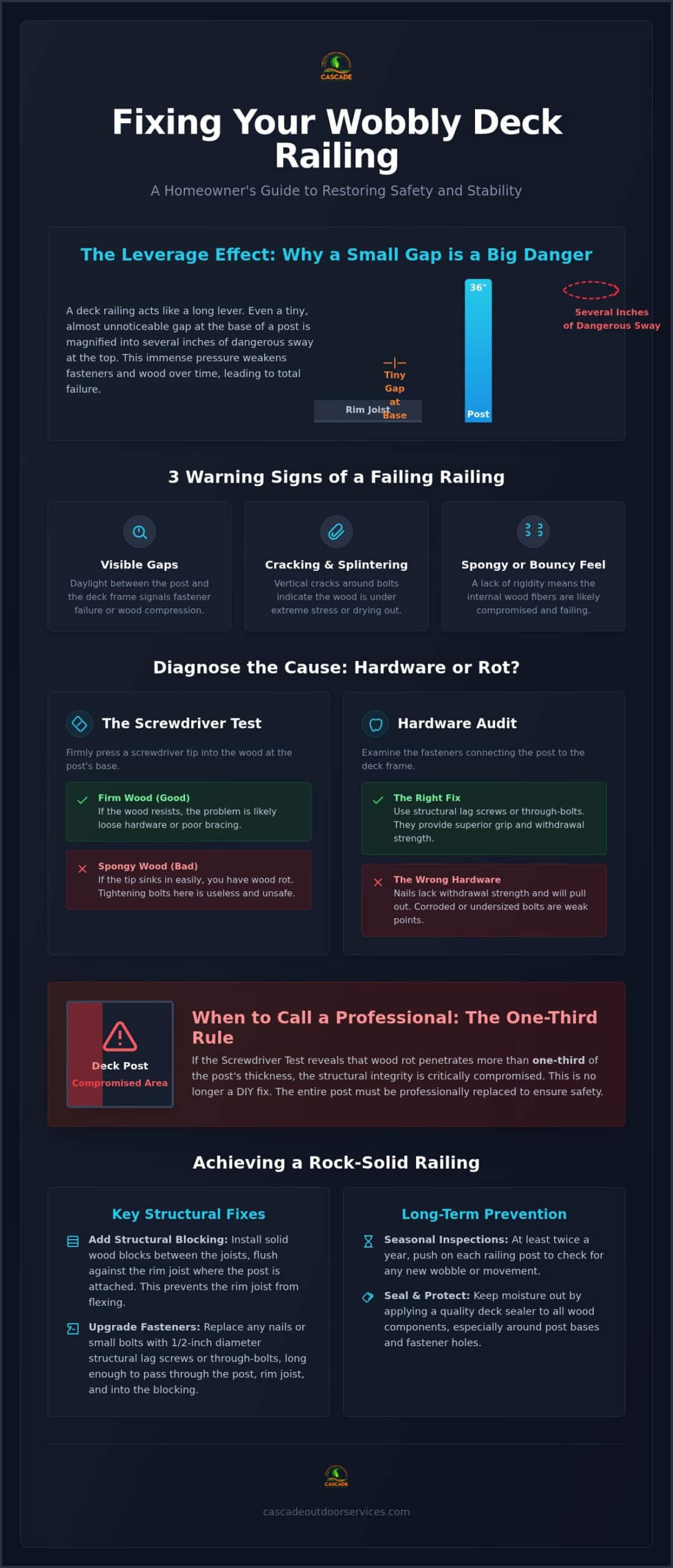
The danger is magnified by what builders call the leverage effect. Most residential guardrails stand 36 inches high. This height creates a powerful lever arm; even a tiny fraction of an inch of “play” at the base of the post translates into several inches of terrifying sway at the top rail. This mechanical advantage puts immense pressure on fasteners. Over time, the constant back-and-forth movement enlarges bolt holes and crushes wood fibers, making the wobble progressively worse until the connection fails entirely.
For homeowners in Johnson County, the local climate acts as a catalyst for these structural issues. Our region’s aggressive freeze-thaw cycles and the high humidity levels we’ve seen throughout 2026 force timber to expand and contract violently. This constant movement naturally loosens lag screws and carriage bolts. In cities like Overland Park and Olathe, a railing that felt secure in the spring can become dangerously loose after a humid Kansas summer or a series of winter storms. This structural fatigue often peaks during large gatherings when multiple guests lean against the perimeter simultaneously.
Common Symptoms of Railing Failure
Identifying a failing railing early can prevent a costly full-scale replacement. Look for these specific warning signs during your next inspection:
- Visible Gaps: Any daylight appearing between the wooden post and the rim joist indicates that the fasteners have pulled through or the wood has compressed.
- Cracking and Splintering: Check the area immediately surrounding the bolt holes. Vertical cracks often signal that the wood is under too much stress or is drying out.
- Spongy Resistance: If the railing feels soft or “bouncy” rather than rigid when you apply pressure, the internal wood grain is likely failing.
Fasteners vs. Structural Integrity
The longevity of deck railing construction depends entirely on the hardware used. Nails should never be used for primary railing connections because they lack the “withdrawal strength” to resist the leverage forces mentioned earlier. They simply pull out over time. While standard carriage bolts were once the industry norm, modern how to fix a wobbly deck railing techniques favor structural lag screws. These fasteners are designed to bite into the wood and stay there. Without proper sealing, moisture often traps itself inside bolt holes, leading to localized rot that eats the connection from the inside out, even if the rest of the post looks healthy.
Diagnosing the Root Cause: Is it Hardware or Rot?
Before you pick up a wrench, you must determine if the instability is a mechanical failure or a biological one. Determining how to fix a wobbly deck railing starts with a thorough diagnosis of the materials. A railing that sways might simply have hardware that has backed out due to vibration and seasonal shifts. It could also be anchored into wood that no longer has the structural integrity to hold a thread. You need to know which one you’re dealing with before attempting a repair.
The most reliable diagnostic tool is the Screwdriver Test. Take a flat-head screwdriver and firmly press the tip into the wood around the post base and the rim joist. If the metal sinks into the timber with little resistance, you’ve identified wood rot. This is a critical distinction; tightening a bolt into rotted wood is like trying to screw into a sponge. It won’t provide the safety your family needs. If the wood remains firm, the issue is likely related to the fasteners or the lack of internal blocking.
Next, perform a hardware audit. Examine the fasteners currently in place. In many older Johnson County homes, decks were built with standard nails or undersized carriage bolts that don’t meet modern 2026 safety standards. Look for signs of “bleeding” or dark streaks on the wood. These indicate that non-galvanized hardware is corroding. Rust doesn’t just look bad; it eats away at the diameter of the bolt. This creates a loose fit that makes learning how to fix a wobbly deck railing a matter of replacement rather than simple adjustment.
Identifying Wood Rot in Joists
Check for dark, localized discoloration or any visible fungal growth where the post meets the frame. Rot often hides in the “sandwich” between the post and the joist where moisture gets trapped. If the wood crumbles when poked, determine if the damage is localized to one post or if it’s systemic across the entire rim joist. Systemic rot often requires a professional deck restoration to ensure the entire perimeter is secure and code-compliant.
Checking Fastener Tension
Go underneath the deck with a flashlight to inspect the connection from below. Look for “mushrooming,” where the washer has been pulled so tight or the wood has softened so much that the hardware is sinking deep into the grain. Check if nuts have backed off the bolts entirely. In the high-humidity environment of a Kansas summer, the wood swells and then shrinks. This cycle can slowly “walk” a nut right off its threads. If you find non-galvanized bolts that are heavily rusted, they must be replaced with hot-dipped galvanized or stainless steel alternatives.
Structural Fixes: Tightening, Blocking, and Lag Bolts
If your screwdriver test confirmed the wood is solid, the wobble is likely a mechanical failure of the fasteners or the frame itself. Most residential decks rely on the rim joist to hold the entire weight of the railing system. Without internal reinforcement, that joist can twist under pressure. Realizing how to fix a wobbly deck railing means moving beyond just tightening a few loose screws; it requires creating a rigid connection that distributes the load across multiple joists.
Your choice of hardware is the most important factor in a long-term fix. While standard carriage bolts were the norm for decades, modern structural lag screws offer superior holding power and corrosion resistance. These fasteners are specifically engineered to pull the post and joist together. Using an impact driver is essential here. The high-torque pulses of a professional-grade driver ensure the fastener is seated deeply enough to compress the wood fibers without stripping the head or snapping the shank in dense, pressure-treated lumber. This emphasis on structural integrity is a hallmark of premium outdoor living spaces, such as those created by BigDecks, where every connection is engineered for long-term safety.
Step-by-Step: Adding Support Blocking
Blocking is the secret to a rock-solid railing. Instead of letting the rim joist take all the force, you’ll install solid wood blocks between the first and second joists. This prevents the rim from rotating when someone leans on the rail. It’s a simple addition that provides a dramatic increase in stability.
- Measure and Cut: Use pressure-treated lumber that matches the depth of your existing joists, typically 2×8 or 2×10. Cut the blocks to fit snugly between the joists.
- Strategic Placement: Position these blocks directly behind each railing post. This creates a solid “sandwich” of wood that the post can anchor into.
- Secure the Block: Drive three-inch structural screws through the adjacent joists and into the ends of your new block. This locks the entire section into a single, unmoving unit.
Installing Structural Tension Ties
For the ultimate level of safety, especially on elevated decks in Shawnee or Leawood, we recommend tension ties. These metal brackets connect the railing post directly to the floor joists, transferring the load away from the rim joist entirely. It’s a professional-grade method that meets the strictest 2026 building codes. This is the most effective way to address how to fix a wobbly deck railing when the leverage forces are extreme.
Start by drilling pilot holes through both the post and the rim joist. Insert heavy-duty galvanized carriage bolts with oversized washers to prevent the head from sinking into the wood. On the inside of the deck frame, attach the tension tie to the bolt and then secure the other end of the tie to the side of the floor joist using structural screws. This creates a continuous load path. It makes it nearly impossible for the post to pull away, regardless of how much pressure is applied to the top rail.
When to Stop DIYing and Call a Professional
While the steps for how to fix a wobbly deck railing are straightforward for minor issues, certain structural “red lines” indicate that the safety of your home is beyond a simple DIY project. One of the most critical metrics we use is the “One-Third Rule.” If our inspection reveals that more than 30% of your rim joist is soft or shows signs of advanced decay, the wood lacks the density to hold structural fasteners safely. In these cases, adding blocks or tightening bolts is just a temporary mask for a failing foundation that requires replacement.
Systemic failure is another major concern for homeowners in Johnson County. If you notice that your railing wobble is accompanied by a visible gap between the deck and your home’s exterior wall, your ledger board may be failing. This is a catastrophic safety risk that requires immediate professional intervention. For property owners with multi-level decks, the physical height of the repair adds another layer of complexity. Working on elevated guardrails requires professional scaffolding and specific liability insurance. Attempting a high-elevation repair without the right gear is a risk that simply isn’t worth taking.
Signs of Advanced Structural Damage
Beyond the railing itself, you should look for hardware that has reached the end of its lifespan. Corroded joist hangers or failing ledger flashing are signs that moisture has been trapped against the house for years. If your posts are not properly notched or were simply “toe-nailed” into the frame by a previous builder, they don’t meet modern safety standards. These systemic issues mean that learning how to fix a wobbly deck railing involves rebuilding the connection points from the ground up to ensure they can withstand the 200-pound lateral load requirement mandated by code.
The Cascade Approach to Structural Safety
We don’t just look at the post; we evaluate the entire ecosystem of your deck frame. Our team uses professional-grade materials and high-torque fastening systems to ensure long-term stability that lasts through decades of Kansas seasons. Often, the moisture causing your wood rot starts at the ground level. You can learn more about our grading and drainage services to see how we protect your home’s exterior from the foundation up. By addressing the source of the moisture, we ensure your deck restoration remains solid for years to come.
If your railing sways more than an inch or you’ve discovered soft wood during your inspection, don’t leave your family’s safety to chance. Contact us for a professional deck building repair and restoration consultation to secure your outdoor living space today.
Preventing Future Wobble with Professional Deck Restoration
Once you have addressed the immediate structural failures, your focus should shift to long-term preservation. The most effective way to ensure you don’t have to search for how to fix a wobbly deck railing again next year is through rigorous moisture management. In Johnson County, wood is constantly under attack from high humidity and heavy precipitation. When water penetrates the grain, it causes the fibers to swell and soften. This softening is what eventually allows fasteners to pull through or the wood around a bolt to rot. Professional restoration isn’t just about aesthetics; it’s about preserving the physical density of the timber so it can hold a structural load.
A proactive approach to maintenance is always more cost-effective than a total structural teardown. We view the deck as a vital extension of the home’s interior, and like any room, it requires consistent upkeep to remain safe and beautiful. By sealing the wood, you create a hydrophobic barrier that prevents the freeze-thaw cycles of a Kansas winter from prying the wood fibers apart. This keeps your connections tight and your guardrails rigid, even during the most demanding seasonal transitions.
The Role of Staining in Structural Health
High-grade stains do more than just provide color. They act as a shield against the UV rays and moisture that cause wood to check and splinter. For railing posts, we recommend deep-penetrating oil stains. These formulas soak into the wood rather than sitting on the surface, providing protection for the internal fibers that hold your lag bolts in place. This is a critical component of our comprehensive guide to deck restoration in Overland Park, where we detail how premium products extend the life of your structural connections.
Homeowners should perform a quick annual inspection to catch minor issues before they become safety hazards. Use this checklist every spring:
- The Water Bead Test: Pour a small amount of water on the post base; if it doesn’t bead up, your sealant has failed.
- Fastener Check: Look for any “bleeding” or rust streaks around bolts.
- The Sway Test: Apply firm lateral pressure to each post to ensure there is zero movement at the base.
- Visual Rot Scan: Check for dark spots or fungal growth where the post meets the decking.
Scheduling Your 2026 Maintenance
Spring is the ideal time to evaluate your deck for any winter-induced wobbles. The expansion of ice in bolt holes can often loosen hardware that was tight the previous autumn. A professional power wash and sanding session removes grayed, dead wood fibers and prepares the surface for a fresh coat of protective sealant. Learning how to fix a wobbly deck railing is a necessary reactive step, but a disciplined maintenance plan prevents the instability from ever resurfacing. You can view our full range of deck restoration services to see how we help local property owners maintain a safe, polished outdoor environment year-round.
Secure Your Sanctuary for the Seasons Ahead
Your deck is a vital extension of your home where safety and aesthetics must coexist. By understanding the leverage forces at play and performing regular diagnostic checks like the screwdriver test, you can stay ahead of the structural fatigue caused by our local climate. Whether you are tightening fasteners or adding internal blocking, knowing how to fix a wobbly deck railing ensures your outdoor space remains a secure retreat for family and friends. It is about the peace of mind that comes from a well-maintained environment and the quiet satisfaction of quality craftsmanship.
When wood rot or systemic failure threatens the integrity of your frame, professional intervention is the only way to guarantee long-term reliability. As a locally owned specialist in Johnson County, KS, Cascade Outdoor Services understands exactly how our regional weather impacts timber. We bring refined craftsmanship and local expertise to every project, transforming neglected spaces into polished, safe environments. Don’t wait for a minor sway to become a major hazard. Get a Professional Deck Evaluation from Cascade Outdoor Services to restore the structural health of your property today. Your deck is an investment worth protecting.
Frequently Asked Questions
Is a wobbly deck railing a code violation in Johnson County?
Yes, a shaky railing is a clear code violation. Residential building codes across Johnson County require guardrails to withstand a 200-pound concentrated load applied in any direction at the top of the rail. If your railing sways when pressure is applied, it fails this essential safety standard. Local inspectors in Shawnee and Leawood view this as a high-priority defect that must be corrected to maintain safety compliance.
Can I just tighten the screws to fix a shaky railing?
You can only fix a shaky railing by tightening screws if the wood fibers are completely intact and the hardware hasn’t stripped the hole. In many cases, the wobble is a symptom of the leverage effect stretching the wood over time. Simply tightening a loose bolt often provides a false sense of security. You likely need to install internal blocking to prevent the rim joist from twisting under pressure.
What is the best hardware for securing a deck post?
Structural lag screws and tension ties are the gold standard for securing posts to the frame. Unlike standard carriage bolts, structural screws are engineered with high-tensile strength and superior corrosion resistance. Using these in conjunction with metal tension ties transfers the load directly to the floor joists. This creates a much more rigid connection than nails or surface-level screws could ever provide during a restoration.
How much does it cost to professionally fix a wobbly railing?
Professional repair costs vary based on the extent of the structural damage and the height of the deck. Minor hardware upgrades are generally affordable, while systemic issues involving rim joist replacement or ledger board repair require a larger investment. Homeowners should consider these repairs an essential part of property maintenance. For assistance with clearing out old materials or broader property upkeep, JBM Custom Contracting offers professional services to keep your home’s exterior in peak condition. Addressing these issues early prevents much more expensive full-scale deck replacements later on.
Can wood rot be fixed without replacing the entire post?
Minor surface rot can sometimes be treated with wood hardeners, but structural rot at the post base usually requires a full replacement. Once the internal fibers of a post have softened, they can no longer safely hold the fasteners required for guardrail stability. Replacing the compromised post is the only way to ensure the railing meets modern safety codes and protects your family during outdoor gatherings.
How often should I inspect my deck railing for stability?
You should inspect your railing at least once a year, preferably in the spring. The freeze-thaw cycles in Kansas cause wood to contract and expand, which naturally loosens fasteners over time. A quick annual check allows you to catch minor play at the post base before it turns into a dangerous structural failure. Regular inspections are the best way to ensure your outdoor living space remains safe year-round.
What happens if a deck railing fails during a home inspection?
A wobbly railing is a major red flag on a home inspection report that can delay a sale or force a price reduction. Buyers and lenders view unstable guardrails as a significant safety liability. Learning how to fix a wobbly deck railing before listing your home prevents these last-minute hurdles. It demonstrates to potential buyers that the property has been meticulously maintained and is ready for immediate use.
Does staining my deck help prevent the railing from getting loose?
Yes, regular staining is a critical preventative measure for long-term stability. High-quality stains repel the moisture that leads to wood softening and rot around fastener holes. By keeping the wood fibers dense and dry, you ensure that the hardware maintains its grip. This is a key part of how to fix a wobbly deck railing long-term, as it stops the biological decay that causes mechanical failure.