
What if the biggest winter risk isn’t the snowfall, but the assumptions hidden in your service agreement? A pre-season snow removal contract should spell out which areas are covered, what triggers service, and how the provider will communicate as conditions change. If those details are vague, property managers may be left uncertain about entrances, parking areas, and safe access during a storm.
Settle those questions before winter demand arrives. This guide explains what to confirm in a commercial snow removal contract, how to compare seasonal and per-event structures, and how to plan for snow, ice, access, and communication at your property. You’ll also learn why a site map, written service triggers, and defined responsibilities matter when comparing providers. Cascade Outdoor Services is locally owned in Johnson County and provides commercial snow and ice management, including 24/7 monitoring and removal. Confirm the specific coverage, services, activation triggers, and contract terms for your property before committing.
Key Takeaways
- A pre-season snow removal contract is easier to evaluate when the property’s coverage and service expectations are documented clearly.
- Compare seasonal, per-event, and hybrid billing by checking what each structure includes and how its terms work.
- Use a site map to identify priority zones, pedestrian routes, entrances, loading areas, and emergency access needs.
- Ask providers to explain activation rules, communication, exclusions, and how they handle overlapping storms or changing site conditions.
- Cascade Outdoor Services is a locally owned Johnson County provider offering commercial snow and ice management with 24/7 monitoring and removal. Confirm property-specific terms directly.
Why Arrange a Pre-Season Snow Removal Contract Before Johnson County Winter?
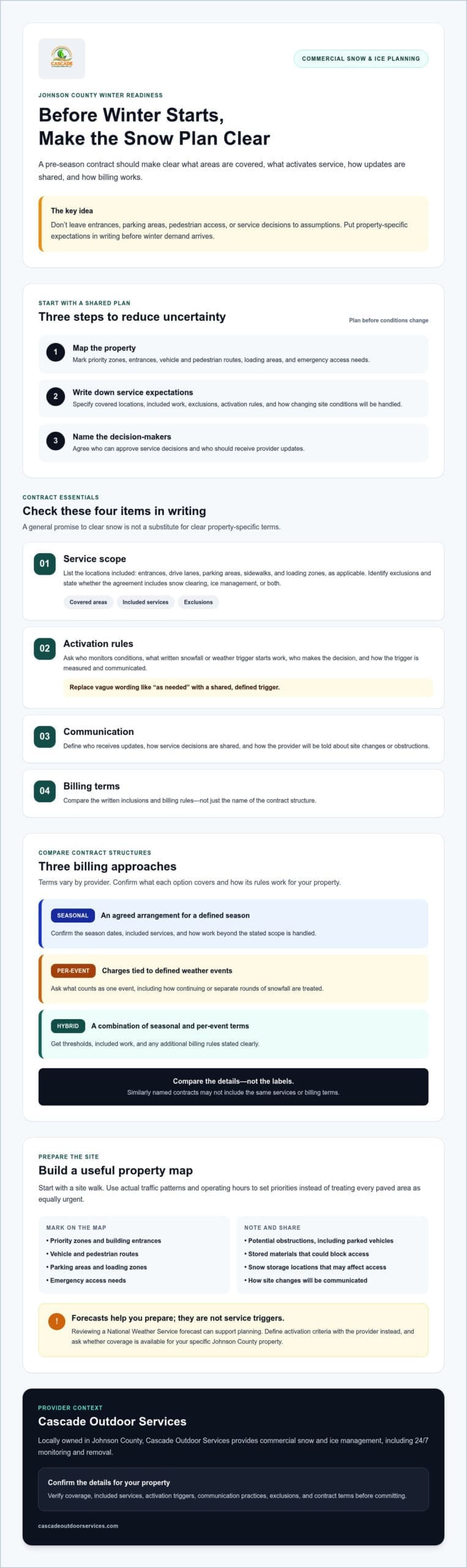
Before the first winter weather event, agree on what the provider is expected to handle and how service decisions will be made. A pre-season snow removal contract gives property teams time to document priority areas, clarify how service is activated, and name the people responsible for communication. That preparation helps prevent confusion when snow or ice affects access and daily operations.
Commercial snow work can involve more than clearing a parking lot. Depending on the property and provider, an agreement may cover different areas and tasks. For background on common snow removal methods, including terms such as de-icing and anti-icing, see Wikipedia. Confirm directly with the provider which services are available and included for your site.
Which properties benefit most from early snow planning?
Business lots, shared HOA drives, building entrances, sidewalks, and loading areas serve different users and may need different priorities. A retail entrance may need attention before customers arrive, while a loading area may matter most around scheduled deliveries. Shared drives require their own plan because residents, visitors, and service vehicles may rely on the same route.
Set priorities based on actual traffic patterns and operating hours rather than treating every paved area as equally urgent. Decide who can approve service decisions and who should receive provider updates. If those roles are unclear, a storm can expose the gap when teams need to coordinate quickly.
What can Johnson County property managers plan before winter?
Start with a site walk. Mark vehicle and pedestrian routes, entrances, loading areas, emergency access needs, and priority zones on a property map. Note potential obstructions, such as parked vehicles or stored materials, and identify places where snow storage could interfere with access. Share the map with the provider and agree on how changes to the site will be communicated.
Reviewing the National Weather Service forecast can help your team prepare for changing conditions, but a forecast is a planning input, not a service trigger. Define activation criteria with the provider instead. Conditions can vary across the Kansas City area, so ask whether the provider serves your specific Johnson County property and has coverage available for it. Confirm the scope and communication process before winter, while there is time to resolve open questions.
What Should a Pre-Season Snow Removal Contract Define?
A useful contract turns a general promise to clear snow into written expectations for your property. Before signing, compare four areas: service scope, activation rules, communication, and billing. This makes it easier to spot gaps between what your team needs and what the provider’s terms actually include. For broader planning, Ready.gov offers guidance on winter weather preparedness for businesses, which can complement your property’s snow service plan.
How should the contract define service scope and activation?
List the areas the provider is expected to address, as applicable: entrances, drive lanes, parking areas, sidewalks, and loading zones. Specify which locations are included and identify exclusions. Don’t assume that snow clearing includes ice management. Ask whether the agreement covers snow clearing, ice management, or both, and make sure the included services are stated in writing.
Next, clarify how service begins. Ask who monitors conditions, what written snowfall or weather trigger activates work, and whether the provider or property representative makes that decision. The contract should explain how the trigger is measured and communicated. This gives both parties a shared expectation instead of leaving the decision to a vague phrase such as “as needed.”
How do seasonal, per-event, and hybrid terms differ?
These structures can suit different budgeting and service needs, but the labels alone don’t tell you what’s covered. Terms vary by provider, so compare the written inclusions and billing rules rather than assuming two similarly named contracts are equivalent.
- Seasonal: An agreed arrangement covers a defined season. Confirm the season dates, included services, and how work beyond the stated scope is handled.
- Per-event: Charges are tied to defined weather events. Ask what counts as one event, including how the provider treats continuing or separate rounds of snowfall.
- Hybrid: Combines elements of seasonal and per-event terms. Get thresholds, included work, and any additional billing rules spelled out clearly.
Give communication and billing the same attention as the service list. Record who receives updates, how service activity is reported, and what information appears on invoices. Confirm how questions or disputed charges are handled. Reviewing these details can reveal unclear terms before winter conditions put the agreement to work.
Once you’ve outlined your site’s needs, compare them with the commercial snow service options available from a Johnson County provider. Confirm the specific scope, activation terms, and billing arrangements directly before committing.
How Can You Compare Snow Removal Providers and Contract Commitments?
Compare providers against the same written criteria, not just the service descriptions in a proposal. A pre-season snow removal contract is easier to evaluate when you can see what each provider covers, how service is activated, and what happens when conditions or site access change.
Written scope makes provider commitments easier to compare. Use a simple table to record each provider’s answers, then ask for unclear terms to be clarified in the agreement.
| Comparison point | What to confirm | Provider A | Provider B |
|---|---|---|---|
| Scope | Which areas and tasks are included? What is excluded? | ||
| Activation | Who monitors conditions, and what written trigger starts service? | ||
| Contact process | Who authorizes service, receives updates, and communicates schedule changes? | ||
| Billing | How are charges determined, and how are extra tasks documented? | ||
| Exclusions | What areas or conditions fall outside the agreement? |
Which questions reveal whether a contract fits your property?
Ask how the provider handles overlapping weather events, including how separate events are defined and whether service continues under the same terms. Discuss changing site conditions as well. If construction, temporary storage, or a layout change blocks an area, find out how the provider will report the limitation and what options are available.
Clarify who can authorize additional work, how approval is recorded, and what documentation you’ll receive. Ask how parked vehicles or other access restrictions affect the agreed scope. These details help avoid assumptions about areas that could not be reached or tasks that were not included.
How should you evaluate reliability without relying on promises?
Request references from commercial properties or HOAs with needs similar to yours, then ask about consistency, communication, and how the provider handled changing conditions. Review relevant insurance documentation and confirm that it fits your organization’s requirements. This is a verification step, not an assumption that a particular credential is legally required.
Compare the provider’s stated capabilities with your property’s operating hours and priority access needs. Read the agreement for defined responsibilities, exclusions, activation terms, and a clear contact path. If an answer remains verbal or ambiguous, request written clarification before deciding. A side-by-side review gives your team a sound basis for comparing commitments without relying on broad assurances.
How Do You Prepare a Johnson County Property for Snow Service?
A clear site plan gives your snow provider a practical guide to the property and helps your team make priorities visible before conditions change. Build it together, then attach the approved map and access notes to the service agreement so expectations are easy to reference.
What should a snow-service site map include?
Start with a current map and mark priority zones. Include the areas that apply to your property:
- Priority drives, parking areas, entrances, sidewalks, and loading zones
- Restricted areas and locations where snow should not be piled
- Curbs, drains, catch basins, and low spots where meltwater may collect
- Pedestrian routes and emergency access needs
Walk the site with the map in hand. Point out obstructions that may be difficult to see under snow, such as curb edges or drainage features, and discuss suitable snow storage locations with the provider in advance. Update the map if access routes, parking layouts, or property use changes. A current plan is more useful than one that no longer reflects the site.
How can you coordinate operations and winter drainage?
Assign a property contact who can share access information, receive service updates, and notify the provider about changes. Add relevant operating details to the site notes, including entrances or loading areas that need particular attention and access restrictions that could affect service.
Snow placement can affect more than parking capacity. Discuss whether proposed storage areas could obstruct drains, catch basins, sightlines, or pedestrian circulation, and consider where meltwater may flow as conditions change. If runoff or low spots are a concern, reviewing the property’s grading and drainage services may help you identify related site considerations. For other exterior needs, Cascade’s commercial property services provide an overview of its offerings.
Use the site walk to confirm the map, access notes, and snow storage plan with your provider. For a Johnson County property, you can also discuss a site-specific commercial snow plan with Cascade Outdoor Services. Confirm service scope, coverage, and terms for your property before winter.
How Can Cascade Outdoor Services Help With a Pre-Season Snow Removal Contract?
Once you’ve outlined your property’s priorities, discuss what a provider can cover and put the agreed terms in writing. Cascade Outdoor Services is locally owned and operated in Johnson County, Kansas, and provides commercial snow and ice management for commercial properties and HOAs. Its commercial service includes 24/7 monitoring and removal. Confirm the specific services, activation rules, communication process, and availability for your property.
A site-specific conversation helps both sides assess whether the proposed coverage fits the property’s layout and operations. Bring the details that will help shape that discussion.
What should you share when requesting a site-specific conversation?
- Property basics: Share the location, property type, and operating hours.
- Site map: Mark priority drives, entrances, pedestrian routes, loading areas, and emergency access needs.
- Site conditions: Note access concerns, drainage features, obstructions, and other constraints that could affect service.
- Questions: Ask which snow and ice services, activation terms, communication arrangements, and contract structures are available for your site.
Be direct about what matters most. If a particular entrance or route is critical during specific operating hours, explain why and ask how the proposed scope addresses it. Confirm current service coverage and capacity for your location rather than assuming that a general service area means availability for every property.
What should you confirm before signing?
Read the final agreement alongside the property map. Check that the written scope matches current access priorities and identifies agreed snow storage areas. Confirm the activation language, who is responsible for communication and decisions, how billing works, and which tasks or areas are excluded. If any service detail is unclear, ask for clarification in writing before approving the agreement.
Keep the signed contract and final map accessible to staff responsible for winter operations. Make sure they know the named service contacts and where to find the agreed terms. This gives your team a shared reference if access needs or site conditions change during the season.
With those details prepared, you can have a focused conversation about a plan for your property. Discuss commercial snow service with Cascade Outdoor Services as you complete your Johnson County winter planning, and confirm the scope and terms that apply to your site.
Set Your Johnson County Property Up for a Clearer Winter
A well-planned pre-season snow removal contract starts with a property-specific scope, written service triggers, and clear communication responsibilities. A current site map helps make priority routes, entrances, and snow storage considerations visible. Comparing seasonal, per-event, or hybrid terms side by side also helps your team understand what’s included and how billing works before winter begins.
Cascade Outdoor Services is locally owned and operated in Johnson County, Kansas. Its commercial snow and ice management includes 24/7 monitoring and removal for commercial properties and HOAs. Confirm the services, availability, activation terms, and contract details for your specific site.
As you finish planning, discuss your commercial snow service needs with Cascade Outdoor Services. A clear conversation now can help your team move into winter with shared expectations and a more orderly plan for access and operations.
Frequently Asked Questions
When should I sign a pre-season snow removal contract?
Arrange a pre-season snow removal contract before winter weather begins, while there’s time to compare providers and clarify your property’s needs. Waiting until a storm is approaching can leave less time to review service scope, activation terms, and availability. There’s no single signing date that fits every property, so start planning early and ask providers about current capacity for your location and the services you need.
What should a commercial snow removal contract include?
A commercial contract should describe the areas and tasks covered, the conditions that activate service, and the process for updates and decisions. It should also explain the billing structure, exclusions, and how additional work is approved and documented. Attach or reference a current site map showing priority areas and access routes. Review each term with the provider so the written agreement reflects your property’s needs, not just a general service description.
What is the difference between seasonal and per-event snow removal contracts?
A seasonal contract covers an agreed winter period, while a per-event contract ties charges to defined weather events. The exact inclusions and billing rules vary by provider. For a per-event arrangement, ask how a continuing storm or separate rounds of snowfall are counted. For seasonal terms, confirm the covered dates and services. A hybrid structure combines approaches, so have its thresholds and charges explained in writing.
Does a snow removal contract include ice management or deicing?
Not necessarily. Snow clearing and ice management may be listed separately, so don’t assume that one includes the other. Ask the provider whether ice management or deicing is available for your property, which areas it applies to, and how it is activated and billed. Make sure the final agreement states what’s included and what falls outside the scope. Confirm the specific services directly before signing.
How are snow removal service triggers defined in a contract?
Service triggers are written criteria that specify when the provider begins work, such as a stated snowfall threshold or another agreed condition. The contract should explain how the trigger is measured, who monitors conditions, and who authorizes or communicates service. Ask how the provider handles changing conditions or overlapping weather events. Clear language helps both parties understand when service starts without relying on a forecast alone or an undefined phrase like “as needed.”
Can an HOA or business customize snow removal priorities for its property?
Yes. An HOA or business can discuss site-specific priorities with a provider and document agreed coverage in the contract and property map. Identify the drives, entrances, pedestrian routes, parking areas, and loading zones that matter most to your operations. Include access constraints and snow storage considerations. Then ask the provider which requested services and terms are available for the site, and confirm the agreed priorities in writing.
What information should I provide when requesting a snow removal contract in Johnson County, KS?
Share the property’s Johnson County location, type, operating hours, and a map of priority areas. Note pedestrian routes, entrances, loading areas, emergency access needs, drainage features, obstructions, and other site constraints. Identify who should receive updates and approve decisions. Ask providers to confirm current coverage, capacity, available services, activation terms, and billing for your specific property. Cascade Outdoor Services is locally owned in Johnson County and provides commercial snow and ice management with 24/7 monitoring and removal.